By SpiritCode | LLM Engineering · Applied AI
There’s a moment every AI-curious engineer hits: you’ve written a clever system prompt, chained a few tools together, and the demo looks great. Then someone from the actual business team says “can it understand what we mean by a ‘C3 deviation’ or a ‘closed-won reforecast’?” and the whole house of cards starts to wobble.
Generic large language models — GPT-4, Llama 3, Mistral — are staggeringly capable at general language tasks. But capability is not the same as fitness. A model trained on the breadth of the internet has, at best, a statistical approximation of your company’s vocabulary, decision frameworks, and internal workflows. For most production use cases, that approximation isn’t good enough.
This article walks through why generic models fail at company-specific logic, how Parameter-Efficient Fine-Tuning (PEFT) and LoRA can fix it, and gives you a conceptual roadmap to start your own fine-tuning pipeline with HuggingFace.
The Problem: Your Business Speaks a Language the Model Never Learned
LLMs learn from distribution. If a term or workflow pattern doesn’t appear frequently in the training corpus — or appears in a different context — the model will hallucinate, generalize incorrectly, or produce plausible-sounding nonsense dressed up in confident prose.
Here are three failure modes that show up constantly in real projects:
1. Domain Jargon and Internal Terminology
Every company, vertical, and team has its own shorthand. A logistics firm may define “last-mile” differently than the supply chain textbooks. A hedge fund’s internal “alpha decay” metric may have a very specific calculation that deviates from the academic definition. A SaaS company’s CRM pipeline stages (“Discover”, “Champion Identified”, “Commit”) are meaningless tokens to a generic model.
When you ask GPT-4 to summarize a Salesforce opportunity or flag a compliance exception against your internal rule set, it’s doing linguistic inference over terminology it has never truly grounded. The output sounds right. It rarely is right under scrutiny.
2. Private Workflows and Decision Trees
Generic models have no knowledge of how your escalation process works, what constitutes a billing dispute resolution, or what the checklist looks like before a feature gets shipped. You can stuff this into a system prompt — and you should, as a first pass — but prompt context is shallow, lossy, and expensive at scale.
More importantly, implicit organizational logic (the stuff your senior employees just know) is incredibly hard to express declaratively in a prompt. It lives in examples, edge cases, and institutional memory.
3. Output Format Constraints and Structured Generation
Many enterprise workflows require the model to produce structured output — JSON payloads, CSV extracts, templated reports — that conform to a very specific schema. While modern models can follow instructions for this, fine-tuning dramatically improves consistency and reduces post-processing overhead.
The Solution: PEFT and LoRA in Plain English
Full fine-tuning a 7B+ parameter model from scratch requires GPU clusters, weeks of compute time, and a team of ML engineers. For most product teams, that is not the path. Enter Parameter-Efficient Fine-Tuning (PEFT).
The core insight behind PEFT is elegant: you don’t need to update every weight in the model to teach it new behavior. You only need to inject small, trainable modules into the existing architecture and train those — leaving the original weights mostly frozen.
LoRA (Low-Rank Adaptation) is the most battle-tested PEFT technique right now. Here’s the intuition:
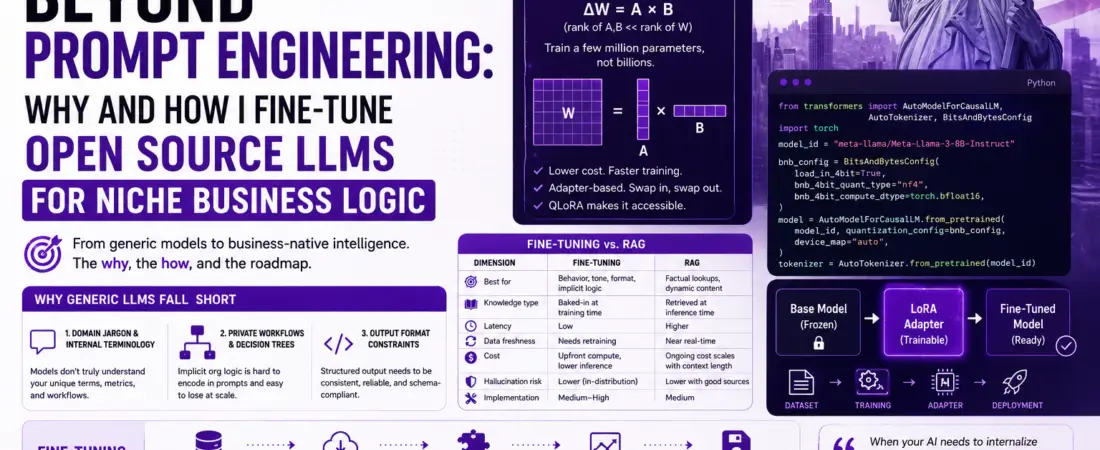
Instead of updating a large weight matrix W directly, LoRA decomposes the update into two small low-rank matrices A and B, where:
ΔW = A × B (where rank of A,B << rank of W)
You inject these adapters into the attention layers of the transformer and train only A and B. The number of trainable parameters drops from billions to millions — or even hundreds of thousands — without significantly sacrificing adaptation quality.
Why this matters for your business case:
- You can fine-tune a 7B model on a consumer-grade A100 or even a high-end RTX 4090 in hours, not weeks.
- The base model weights stay intact. You can swap adapters in and out at inference time.
- It’s cost-effective enough to iterate rapidly as your business logic evolves.
QLoRA takes this further by quantizing the base model weights to 4-bit precision during training, cutting memory requirements dramatically and making fine-tuning accessible on even more modest hardware.
Fine-Tuning vs. RAG: Choosing Your Weapon
Before you commit to fine-tuning, it’s worth being honest about when Retrieval-Augmented Generation (RAG) is the better tool. These two approaches solve related but distinct problems.
| Dimension | Fine-Tuning | RAG |
|---|---|---|
| Best for | Behavioral patterns, tone, format, implicit logic | Factual lookups, dynamic/frequently updated content |
| Knowledge type | Baked-in at training time | Retrieved at inference time |
| Latency | Low (no retrieval step) | Higher (requires vector search + context stuffing) |
| Data freshness | Requires retraining on updates | Near real-time with updated vector store |
| Cost | Upfront compute cost, lower inference cost | Ongoing inference cost scales with context length |
| Hallucination risk | Reduced for in-distribution inputs | Reduced when source documents are high-quality |
| Implementation complexity | Medium-high (requires labeled data, training pipeline) | Medium (requires chunking strategy, embedding model, retrieval logic) |
The pragmatic answer? Most production systems use both. Fine-tune for behavioral alignment and output format consistency. Layer RAG on top for factual grounding and dynamic document retrieval. The two are not mutually exclusive — they’re complementary layers of a well-engineered AI stack.
Conceptual Roadmap: Fine-Tuning with HuggingFace PEFT
Here’s a high-level walkthrough of the pipeline. This is intentionally conceptual — real training runs require data curation and hyperparameter tuning specific to your use case — but this gives you the skeleton to build on.
Step 1: Prepare Your Dataset
Your fine-tuning dataset should be a set of (instruction, input, output) triples — examples of the behavior you want the model to learn. Quality beats quantity here. Two hundred carefully crafted, representative examples will outperform two thousand noisy ones.
# Example dataset structure (Alpaca-style format)
dataset = [
    {
        "instruction": "Classify this support ticket by priority level based on our internal SLA policy.",
        "input": "Customer reports checkout button unresponsive on mobile Safari. Tier 2 account.",
        "output": "Priority: HIGH. Reason: Tier 2 accounts have a 4-hour response SLA. Mobile checkout failures are revenue-impacting and affect conversion metrics."
    },
    # ... more examples
]
Step 2: Load Base Model with Quantization
from transformers import AutoModelForCausalLM, AutoTokenizer, BitsAndBytesConfig
import torch

model_id = "meta-llama/Meta-Llama-3-8B-Instruct"

bnb_config = BitsAndBytesConfig(
    load_in_4bit=True,
    bnb_4bit_quant_type="nf4",
    bnb_4bit_compute_dtype=torch.bfloat16,
)

model = AutoModelForCausalLM.from_pretrained(
    model_id,
    quantization_config=bnb_config,
    device_map="auto",
)
tokenizer = AutoTokenizer.from_pretrained(model_id)
Step 3: Configure LoRA Adapters
from peft import LoraConfig, get_peft_model, TaskType

lora_config = LoraConfig(
    r=16,                        # Rank of the update matrices
    lora_alpha=32,               # Scaling factor
    target_modules=["q_proj", "v_proj"],  # Which attention layers to target
    lora_dropout=0.05,
    bias="none",
    task_type=TaskType.CAUSAL_LM,
)

model = get_peft_model(model, lora_config)
model.print_trainable_parameters()
# Output: trainable params: 4,194,304 || all params: 8,034,516,992 || trainable%: 0.052
Step 4: Train with SFTTrainer
from trl import SFTTrainer
from transformers import TrainingArguments

training_args = TrainingArguments(
    output_dir="./spiritcode-llm-adapter",
    num_train_epochs=3,
    per_device_train_batch_size=4,
    gradient_accumulation_steps=2,
    learning_rate=2e-4,
    bf16=True,
    logging_steps=10,
    save_strategy="epoch",
)

trainer = SFTTrainer(
    model=model,
    args=training_args,
    train_dataset=your_hf_dataset,
    dataset_text_field="text",
    max_seq_length=2048,
)

trainer.train()
Step 5: Save and Load Adapter Weights
# Save only the adapter weights — a few hundred MB, not the full 16GB model
model.save_pretrained("./spiritcode-adapter-v1")

# At inference time, merge adapter back onto the base model
from peft import PeftModel
base_model = AutoModelForCausalLM.from_pretrained(model_id, ...)
fine_tuned_model = PeftModel.from_pretrained(base_model, "./spiritcode-adapter-v1")
Final Thoughts
Prompt engineering is a legitimate and powerful tool. But treating it as the ceiling is a mistake. When your AI product needs to internalize company-specific logic — not just look it up, but reason with it natively — fine-tuning is the mechanism that closes that gap.
Start small. Curate a focused dataset. Run QLoRA on a 7B model. Evaluate against your real use cases. The operational overhead is far lower than it was two years ago, and the payoff — a model that genuinely speaks your business’s language — is substantial.
SpiritCode publishes technical writing at the intersection of engineering craft and systems thinking. If this resonated, share it with your team.