
By SpiritCode | Security Engineering · DevOps Culture
There’s a mental model baked into most corporate security infrastructure that goes something like this: inside the network is safe, outside is hostile. The VPN was the drawbridge. Get across it, and the castle trusts you.
That model is dead. It has been dead for a while. What’s surprising is how many engineering organizations — including ones full of smart, security-conscious people — are still operating as if it isn’t.
This is a hands-on guide to implementing Zero Trust Architecture for distributed engineering teams. Not the marketing version of Zero Trust. The practical, occasionally uncomfortable, culturally-aware version that actually gets deployed.
The Problem: The Perimeter Was Always an Illusion
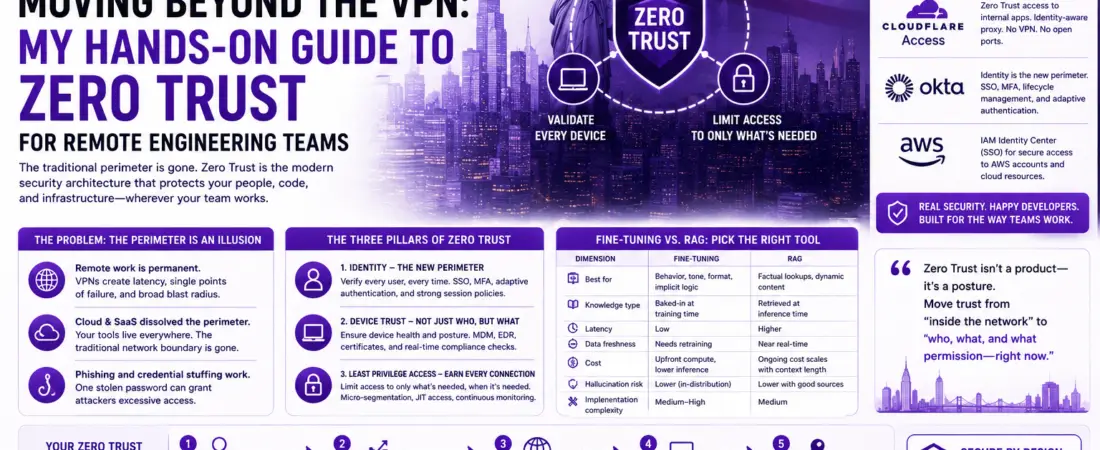
The “trusted internal network” assumption was always shaky, but several converging forces have made it untenable:
Remote work is permanent, not transitional. When your engineers are distributed across cities, countries, and time zones, the “inside” of your network is a fiction. VPN splits your traffic, creates latency nightmares, and introduces a single point of failure in your access model. A compromised VPN credential grants broad lateral movement across your infrastructure — the attacker just became an “insider.”
Cloud and SaaS have dissolved the perimeter. Your codebase lives in GitHub. Your CI/CD pipeline runs on AWS or GCP. Your observability stack is Datadog. Your project management is Linear or Jira. None of these are “inside.” The concept of a perimeter protecting them is cosmetic.
Credential stuffing and phishing remain devastatingly effective. Once an attacker has a valid username and password — perhaps from a breach on a reused password — a VPN-first model often grants them access to everything the compromised user had access to. That’s the blast radius problem.
Zero Trust doesn’t eliminate these risks. Nothing does. But it structurally limits the blast radius of any individual failure and demands continuous verification at every access point.
The Three Pillars of Zero Trust for Engineering Teams
Zero Trust isn’t a product — it’s an architecture built on a few core principles. For remote engineering teams, there are three pillars that matter most.
Pillar 1: Identity — The New Perimeter
In a Zero Trust model, identity is the control plane. Every access decision starts with: who is this, and can we verify it right now?
This means your Identity Provider (IdP) becomes critical infrastructure. For most engineering organizations, that’s Okta, Azure AD, or Google Workspace. What matters is that:
- SSO is enforced across all tooling. Engineers authenticate to one authoritative source, not a patchwork of individual app passwords.
- MFA is non-negotiable — and preferably phishing-resistant MFA (FIDO2/WebAuthn hardware keys or passkeys, not SMS codes).
- Session lifetime and re-authentication policies are calibrated. A session that stays valid indefinitely regardless of context is a liability.
The sophistication layer on top of this is adaptive authentication — where access decisions factor in behavioral signals (new device, unusual geography, anomalous access time) and dynamically step up verification requirements. This is where tools like Okta Adaptive MFA or Cloudflare Access’s policy engine earn their keep.
Pillar 2: Device Trust — Not Just Who, But What
Identity answers who. Device trust answers what are they using to access your systems?
A valid Okta session on a personal, unmanaged laptop with no disk encryption, running a three-year-old OS with known CVEs, is not a trustworthy access request. Zero Trust requires that device health is part of the access decision.
For engineering teams, this typically involves:
- MDM enrollment (Jamf for macOS, Intune for cross-platform) to enforce baseline policies: disk encryption, screen lock, OS patch level, EDR agent running.
- Device posture checks at the access layer. Cloudflare Access and Tailscale both support posture integrations that can gate access to services based on real-time device health signals.
- Certificate-based authentication so that only enrolled, managed devices can present a valid client certificate alongside user credentials.
This is where pushback from developers often emerges, and we’ll address that in the culture section. The key framing: device trust isn’t surveillance. It’s ensuring that the endpoint through which company resources are accessed meets a defined hygiene bar.
Pillar 3: Least Privilege Access — Earn Every Connection
The traditional model: get through the VPN, access everything your role might plausibly need, maybe more. The Zero Trust model: every service, every resource, every API — accessed only by identities and devices that have explicit, time-bound, audited permission to do so.
In practice for engineering teams, this means:
- Service-level access controls rather than network-level. Access to the production database is not granted to all engineers by virtue of being “on the network.” It’s granted to specific roles, with JIT (just-in-time) elevation for sensitive resources.
- Micro-segmentation of your internal services so that compromise of one component doesn’t grant lateral movement to others.
- Continuous logging and anomaly detection on access patterns, not just at the perimeter.
Practical Tooling: What’s Actually Worth Using
Let’s talk tools — concretely, without pretending any of them is a silver bullet.
Tailscale is the most developer-friendly Zero Trust networking layer available today. It uses WireGuard under the hood, which means fast, low-latency encrypted tunnels. Engineers install an agent; their devices join a private mesh network where every node is authenticated. ACLs are defined in a simple JSON policy file checked into version control. For small-to-mid-size teams that want to eliminate the traditional VPN quickly without a massive infrastructure overhaul, Tailscale is often the right first move. Its ACL model maps naturally onto how engineering teams think about access.
Cloudflare Access (part of Cloudflare Zero Trust / WARP) sits in front of your internal applications and services as a reverse proxy. Instead of exposing services to a VPN, you expose them through Cloudflare’s edge, which enforces identity-based access policies before any request reaches your infrastructure. It integrates cleanly with Okta, GitHub, Google Workspace — wherever your identity lives. The cloudflared tunnel daemon means you never have to punch holes in your firewall. For web-based internal tooling (dashboards, admin panels, internal APIs), it’s remarkably low-friction to deploy.
Okta remains the category leader for enterprise identity. For engineering teams, the combination of Okta SSO + Okta Workflows (for automated deprovisioning and access review triggers) + Okta Verify provides a solid identity foundation. It’s not cheap, but neither is a breach enabled by stale access credentials.
AWS IAM Identity Center (formerly SSO) is worth a mention for teams whose primary attack surface is cloud infrastructure. Centralizing AWS account access through IAM Identity Center with short-lived credential vending dramatically reduces the risk of long-lived access key exposure.
The Cultural Shift: Security That Doesn’t Break Developers
Here is where most Zero Trust implementations either succeed or fail, and it has nothing to do with the technology.
Developers have a high sensitivity to friction. Any security control that meaningfully degrades the experience of writing, deploying, or debugging code will be worked around, complained about loudly, or quietly ignored. That’s not a character flaw — it’s a rational response to productivity pressure.
The implementation playbook that works:
Start with transparency, not mandates. Bring the engineering team into the “why” before deploying the “what.” Explain the threat model. Walk through what a lateral movement attack looks like post-credential-compromise. Engineers are problem-solvers; once they understand the actual problem, they become collaborators on the solution rather than resistors.
Pick tooling that respects developer workflows. Tailscale’s CLI is designed for developers. Cloudflare Access with GitHub SSO is nearly invisible once set up. The closer the tool is to “it just works,” the lower the adoption friction. Tools that require manual steps for every sensitive operation, or that generate constant re-authentication prompts, will be resented.
JIT access for sensitive resources, not friction for everything. Not every system needs the same access bar. Treat production database access, secrets management, and deployment pipelines with high ceremony. Let developers access development and staging environments, internal documentation, and observability dashboards with low friction. Calibrate the security posture to the actual risk level of each resource.
Automate the boring compliance work. Access reviews, deprovisioning on offboarding, quarterly permission audits — these are where manual security processes break down. Okta Workflows, AWS IAM Access Analyzer, and similar automation tools should handle this so no human has to track it in a spreadsheet.
Measure and report on security posture as a team metric, not just an audit artifact. Mean time to detect, mean time to revoke over-permissioned access, percentage of services behind Zero Trust controls — make these visible, celebrate improvements, and tie them to team health rather than compliance anxiety.
The Migration Path: You Don’t Flip a Switch
Real organizations migrate to Zero Trust incrementally, not in a single cutover. A pragmatic sequence for engineering teams:
- Harden identity first. Enforce MFA everywhere. Audit and eliminate stale accounts. Set up SSO for all critical tooling. This is the highest ROI step and the least disruptive.
- Instrument and observe before restricting. Deploy logging and access monitoring before tightening controls. Understand what your actual access patterns look like so you don’t accidentally cut off legitimate workflows.
- Replace VPN for application access progressively. Stand up Cloudflare Access or Tailscale alongside your existing VPN. Migrate services one at a time. Retire the VPN only when the migration is complete and stable.
- Implement device trust incrementally. Start with MDM enrollment as a soft requirement, then make it a hard gate over a defined window. Give engineers time to enroll their devices and resolve issues before access is blocked.
- Build JIT access for sensitive resources. Once the foundation is solid, layer in just-in-time privilege elevation for production access, secrets, and high-impact deployment operations.
Where This Leaves You
Zero Trust is not a project you complete. It’s an ongoing posture — a discipline that needs to evolve as your infrastructure, team, and threat landscape change.
But the directional shift is clear and urgent: move the trust decision from “are you inside the network?” to “who are you, what are you using, and do you have explicit permission for this specific action right now?”
For remote engineering teams, this isn’t a downgrade in the developer experience. Done well, it’s an upgrade — fewer broad permissions, less anxiety about what a compromised credential could expose, and infrastructure designed to tolerate the reality that breaches happen. The question is whether your architecture is built to contain them.
SpiritCode publishes technical writing at the intersection of engineering craft and systems thinking. If this resonated, share it with your team.