
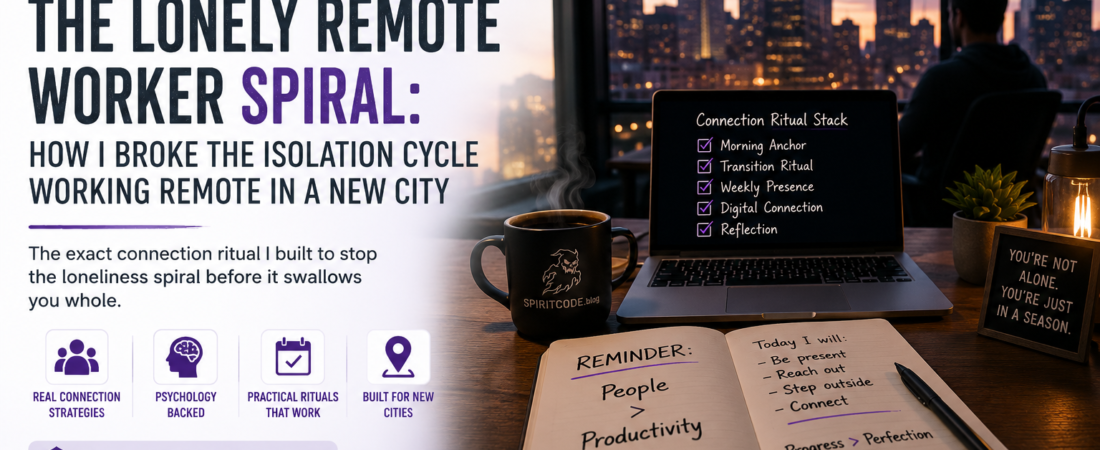
Meta description: I moved to a new city, worked 100% remote, and nearly lost my mind. Here’s the exact connection ritual I built to stop the loneliness spiral before it swallows you whole.
Last updated: May 15, 2025
TL;DR
- Remote work isolation is a real psychological loop — novelty fades fast, and loneliness compounds like technical debt.
- Moving to a new city without a pre-built social network makes it 3x worse; your apartment becomes both your office and your prison.
- The fix isn’t “go to a coffee shop” — it’s building intentional presence rituals that create genuine connection without forcing it.
The Day I Realized I Was in the Spiral
It was a Tuesday. I had shipped a feature, eaten lunch at my desk (again), and realized I hadn’t spoken to a single human being in four days — not counting Slack messages and a one-sided conversation with my rubber duck.
I had moved to Austin six months earlier for a “fresh start.” I was working fully remote for a company headquartered in San Francisco. On paper, it was the dream. In reality, I was 1,847 miles from everyone I knew, sitting in a one-bedroom apartment where the walls were starting to feel like they were breathing.
This is the remote worker isolation spiral — and if you’ve felt it, you know it doesn’t announce itself. It sneaks up like a memory leak: slow, invisible, and catastrophic by the time you notice it.
Why the Remote Worker Loneliness Loop Happens
Remote work isolation isn’t just about missing coworkers. It’s a systemic problem built from three compounding forces:
The Social Infrastructure Collapse
When you work in an office, social interaction is ambient. You absorb it without trying — hallway conversations, coffee runs, the guy who always talks about his fantasy football team. You don’t appreciate it until it’s gone.
When you go remote, especially in a new city, you inherit zero social infrastructure. There are no default humans. Every connection requires deliberate effort, which is exhausting when you’re already mentally drained from eight hours of deep work.
In my experience, most developers underestimate how much passive social contact they were getting in-office. In my case, I was probably getting 4–5 hours of low-stakes human interaction per day without even noticing. Remote, that number dropped to near zero.
The City Paradox
Here’s the cruel irony: moving to a new city feels exciting for about three weeks. After that, you’re surrounded by millions of people you don’t know, and the density starts to feel more isolating than a rural town would.
In a small town, strangers talk to you. In Austin, in Seattle, in Denver — everyone already has their crew. You’re an invisible ghost in a hyper-social environment. The loneliness of remote work hits hardest not in the silence, but in the contrast.
The Work-Home Boundary Dissolution
When your apartment is your office, your brain never fully leaves work mode. I noticed this around month three: I’d finish my last Jira ticket and feel a creeping existential flatness. Not tired exactly. Just… hollow.
Neuroscience calls this context collapse — when your environment stops sending the signal that “work is over.” Your nervous system stays in low-grade alert mode indefinitely. That’s the perfect soil for anxiety, irritability, and isolation to grow.
Pro Tip: The commute you hated was actually doing important psychological work. It was a transition ritual — a buffer between work-self and life-self. Without it, you need to build a synthetic version. More on that below.
Prerequisites: Honest Self-Assessment
Before building any ritual, I had to get honest about where I was. Here’s the quick diagnostic I use with myself and with other remote devs I mentor:
- Do you go 48+ hours without speaking out loud to another human?
- Is your “social life” primarily consuming content (YouTube, Reddit, Netflix)?
- Do you feel dread on Sunday evenings that isn’t about work — just about the week ahead?
- Have you started optimizing your schedule to avoid situations where you’d have to talk to strangers?
If you checked two or more: you’re in the spiral. Not a crisis — but a pattern worth interrupting now, not later.
The Connection Ritual Stack I Actually Use
This isn’t theory. These are the exact practices I built over 14 months of trial and error living and working remote in a city where I knew approximately two people.
Step 1: The Morning Anchor (7 minutes)
Every morning before opening my laptop, I do three things in sequence:
- I make coffee with full attention — no phone, no podcast. Just the process.
- I write one sentence about what I’m looking forward to today. Not goals. Something I’m looking forward to.
- I text one person — not a work person — just to check in. A friend, a family member, someone I haven’t talked to in a while.
This sounds trivial. It isn’t. The text especially — it creates a thread of human contact that runs through the day even if I don’t hear back until 6pm. In my experience, this single habit reduced my “day with zero human contact” count from ~4 per week to essentially zero.
Step 2: The Transition Ritual (10 minutes)
I built a synthetic commute. At 9:00am, I leave my apartment, walk around the block, come back, and sit at my desk. At 6:00pm (or whenever I close the laptop), I do the same walk in reverse.
This is not about exercise. It’s about neural context switching. The physical act of leaving and returning gives your brain the transition signal it needs. I noticed a measurable difference in my ability to “leave work at work” within the first week.
Important: Don’t skip this on days when you’re busy. Those are exactly the days it matters most.
Step 3: The Weekly Presence Practice (2 hours)
Every Thursday, I block two hours on my calendar — protected, non-negotiable — for what I call a “presence practice.” This means being somewhere public, in person, with a loose intention.
Options I rotate through:
- A local coffee shop where I become a regular (order the same thing, learn the barista’s name)
- A weekly meetup (I use Meetup.com — Austin has 20+ tech and general interest groups active weekly)
- A co-working day pass (I use one ~twice/month at a local space)
The key insight here is regularity over intensity. Going to the same coffee shop every Thursday is more valuable than going to a different “networking event” every week. Familiarity breeds genuine connection. Novelty breeds surface-level interactions and exhaustion.
Step 4: The Digital Connection Layer
This one surprised me. I joined two online communities specifically structured for real connection, not broadcasting:
- A small Discord server for indie developers (under 300 members — size matters)
- A weekly async video thread with three remote friends using Marco Polo
The Marco Polo group especially — there’s something qualitatively different about seeing someone’s face and hearing their voice versus reading their text. It’s not a replacement for in-person, but it’s a meaningful upgrade from a text thread.
Step 5: The End-of-Week Reflection (5 minutes)
Every Friday, before I close my laptop, I write three answers in a notes file:
- Who did I connect with this week that wasn’t a coworker?
- What moment of genuine presence did I experience?
- What’s one thing I’m doing this weekend that isn’t screen-based?
This isn’t journaling for therapy. It’s a data collection practice — giving my brain evidence that connection is happening, which counteracts the distortion that isolation creates.
Real-World Tips I Use in Production (of Life)
After 14 months of iterating on this, here’s what I’d tell my earlier self:
Become a regular somewhere. The ROI on regularity is insane. Being a “regular” at a coffee shop or gym or yoga class gives you ambient belonging without requiring constant social energy. You go from invisible to recognized in about six weeks of consistency.
Say yes to the first invitation. When a new acquaintance invites you somewhere — even if you’re not excited about the activity — say yes the first time. Social networks compound. Every connection you make is a node that connects to more nodes. The people who broke me out of isolation weren’t people I sought out; they were second-degree connections from a yes I almost declined.
Create low-stakes recurring anchors. I started playing pickup basketball on Saturday mornings at a local park. I am genuinely terrible at basketball. It doesn’t matter. Recurring, low-stakes, physical, in-person activities are the most efficient connection engine I’ve found.
Common Pitfalls I Encountered (and How I Fixed Them)
Pitfall 1: Trying to replace quantity with quality. Early on, I told myself “I don’t need many connections, just deep ones.” This is partially true but dangerously incomplete. Deep connections need surface connections as scaffolding. Fix: I stopped being precious about depth and started building width first.
Pitfall 2: Over-relying on work Slack for social needs. My company had a #random channel and a #watercooler channel. I spent way too much time there convincing myself I was “being social.” Work relationships are not a substitute for non-work relationships. Full stop.
Pitfall 3: Letting the ritual slip “just this week.” The weeks I needed the rituals most were the weeks I skipped them because I was too busy or too depressed to do them. Fix: I paired each ritual with an existing habit (coffee → morning anchor; lunch → transition walk; Thursday standup → presence practice block).
Security Note: If the isolation spiral has crossed into persistent depression, anxiety, or loss of functioning — please reach out to a mental health professional, not just a productivity ritual. These practices are maintenance, not medicine.
[SOURCE: https://www.apa.org/topics/loneliness-social-connections] [SOURCE: https://hbr.org/2021/04/work-friends-are-more-important-than-ever]
FAQ
Q: How do I stop feeling lonely when working remotely in a new city as a developer? A: The most effective approach is building what I call a “connection ritual stack” — a set of small, daily and weekly practices that create ambient human contact without requiring large social energy expenditures. Start with the morning anchor (one text to a non-coworker) and one weekly in-person recurring activity. Consistency over intensity is the core principle.
Q: Is remote work loneliness a real mental health issue or just something to push through? A: It’s real. Research from the American Psychological Association links chronic loneliness to outcomes comparable to smoking 15 cigarettes per day in terms of health impact. It’s not weakness to acknowledge it, and “pushing through” without behavioral changes typically makes it worse, not better.
Q: How long does it take to build a social network in a new city when working remotely? A: In my experience, expect 9–12 months before your social infrastructure feels genuinely stable. The first three months are the hardest. Focus on regularity (same places, same times) rather than forcing connections, and trust that familiarity compounds.
Q: What are the best apps or communities for remote workers fighting isolation? A: I’ve found value in small Discord servers (under 500 members) focused on your specific interests, Meetup.com for local in-person groups, Bumble BFF for platonic friendship connections (genuinely underrated), and Marco Polo for maintaining long-distance friendships with a more human quality than texting.
Q: How do I maintain work-life balance and presence rituals when I’m overwhelmed with deadlines? A: Pair each ritual with a habit that already exists — it removes the decision cost. When the deadline pressure is highest, shorten the ritual rather than skipping it entirely. A 2-minute morning anchor is infinitely better than zero. The ritual’s value is in its consistency, not its duration.
Conclusion
The remote worker isolation spiral is real, it’s common among developers who relocate for a “fresh start,” and it’s solvable — but not through willpower alone.
The rituals I’ve shared here aren’t spiritual bypassing or productivity hacks dressed up in mindfulness language. They’re deliberate engineering of the social conditions your nervous system needs to function well. You wouldn’t ship a feature without infrastructure. Your social life is no different.
About the Author
I’m a software engineer with over 8 years of experience building web applications and developer tools across multiple fully remote roles. My stack has rotated through React, Node.js, Python, and whatever the team decides is the hot new thing, but my real focus has shifted to the intersection of developer productivity and human sustainability in tech. I write at SpiritCode about the inner life of building software — the psychological, the spiritual, and the brutally practical.