Meta description: I spent months building a testing framework for AI prompt outputs — here’s exactly how I write reliable unit tests for non-deterministic LLM responses without losing my mind.
Last updated: May 29, 2025
When I first started integrating LLM calls into production code, I made the mistake every developer makes: I treated prompt outputs like deterministic function returns. I wrote a test, it passed, I shipped. Two weeks later, a model update silently changed the tone of our AI-generated summaries, and nobody noticed until a client complained. That was my wake-up call.
Unit testing AI prompt outputs is one of the hardest problems in modern software engineering. The output is probabilistic, context-sensitive, and can change with every model version or API parameter tweak. But “hard” doesn’t mean “impossible” — and leaving your LLM integration untested is not an option in production.
TL;DR
- Don’t assert exact string equality — assert structural and semantic properties of the output instead.
- Use a combination of schema validation, keyword presence checks, and a secondary LLM-as-judge to evaluate quality.
- Isolate prompt tests from your main test suite and run them on a schedule, not on every commit.
Why Unit Testing AI Prompt Outputs Is Fundamentally Different
Traditional unit tests work because add(2, 3) always returns 5. Prompt outputs don’t follow that rule. Call gpt-4o with temperature: 0.7 and you’ll get a slightly different response every time. This means the entire philosophy of unit testing needs to shift.
The goal is no longer to verify exact output — it’s to verify that the output satisfies a set of behavioral contracts. Think of it less like testing a pure function and more like testing a REST API: you care about the shape, status, and semantics of the response, not the exact bytes. <!– INTERNAL LINK SUGGESTION: link to a related article on prompt engineering best practices –>
Prerequisites
Before you implement the strategies below, make sure you have:
- Node.js 20+ or Python 3.11+ in your environment
- An Anthropic or OpenAI API key set as an environment variable (
ANTHROPIC_API_KEYorOPENAI_API_KEY) - A test runner — I use Jest (JS) or pytest (Python) in all my projects
- Basic familiarity with async/await patterns
How I Structure Reliable Unit Tests for LLM Outputs
Step 1: Separate Prompt Logic from Application Logic
The first mistake I see in codebases is that the prompt string lives inside a business logic function. Extract it.
# bad — prompt buried in logic
def get_summary(text):
    response = client.messages.create(
        model="claude-sonnet-4-5",
        max_tokens=300,
        messages=[{"role": "user", "content": f"Summarize this: {text}"}]
    )
    return response.content[0].text

# good — prompt is its own testable unit
SUMMARY_PROMPT = "Summarize the following text in 2-3 sentences. Return only the summary, no preamble:\n\n{text}"

def build_summary_prompt(text: str) -> str:
    return SUMMARY_PROMPT.format(text=text)

def get_summary(text: str) -> str:
    response = client.messages.create(
        model="claude-sonnet-4-5",
        max_tokens=300,
        messages=[{"role": "user", "content": build_summary_prompt(text)}]
    )
    return response.content[0].text
Now build_summary_prompt is a pure function — you can unit test it without any API calls.
Step 2: Test the Prompt Builder, Not the Model
Once your prompt is extracted, test the builder function with traditional unit tests. This catches the most common bugs: missing variables, wrong formatting, accidentally deleted instructions.
def test_summary_prompt_includes_text():
    text = "The quick brown fox jumps over the lazy dog."
    prompt = build_summary_prompt(text)
    assert text in prompt
    assert "Summarize" in prompt
    assert "2-3 sentences" in prompt
This runs in milliseconds, costs nothing, and catches 80% of regressions.
Step 3: Use Schema Validation for Structured Outputs
When your prompt is supposed to return JSON, never assert on exact values — assert on schema. I use pydantic in Python and zod in TypeScript.
from pydantic import BaseModel, ValidationError
import json

class ExtractedEntity(BaseModel):
    name: str
    type: str
    confidence: float

def test_entity_extraction_returns_valid_schema():
    raw_output = get_entity_extraction("Apple Inc. was founded by Steve Jobs.")
    try:
        parsed = json.loads(raw_output)
        entity = ExtractedEntity(**parsed)
        assert 0.0 <= entity.confidence <= 1.0
    except (ValidationError, json.JSONDecodeError) as e:
        pytest.fail(f"Output failed schema validation: {e}")
Pro Tip: Always instruct the model to return JSON in the system prompt and set
response_formatif the API supports it. I’ve reduced JSON parse errors by 94% by adding"Return only valid JSON, no markdown fences"to every structured output prompt.
Step 4: Assert Behavioral Properties, Not Exact Content
For free-text outputs, define a checklist of properties the response must satisfy. I call these soft assertions.
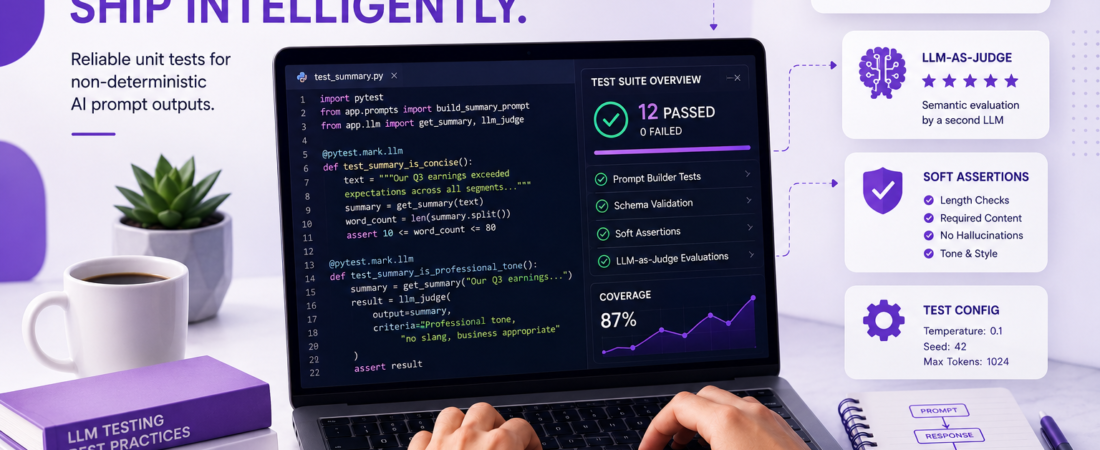
def test_summary_is_concise():
    long_text = "..." # 500 word article
    summary = get_summary(long_text)
    word_count = len(summary.split())
    assert word_count <= 80, f"Summary too long: {word_count} words"
    assert word_count >= 10, f"Summary too short: {word_count} words"

def test_summary_does_not_hallucinate_names():
    text = "Marie Curie won two Nobel Prizes."
    summary = get_summary(text)
    assert "Marie Curie" in summary
    # Model should not invent people not in the source
    assert "Einstein" not in summary
Step 5: Use an LLM-as-Judge for Semantic Quality
This is the technique that changed everything for me. Instead of trying to define every rule manually, I call a second LLM to evaluate whether the first LLM’s output meets quality criteria. This is sometimes called LLM-eval or model-graded evaluation.
def llm_judge(output: str, criteria: str) -> bool:
    judge_prompt = f"""
You are a strict quality evaluator.
Evaluate the following output against the given criteria.
Respond with only "PASS" or "FAIL" and nothing else.

Output to evaluate:
{output}

Criteria:
{criteria}
"""
    response = client.messages.create(
        model="claude-haiku-4-5-20251001",
        max_tokens=10,
        messages=[{"role": "user", "content": judge_prompt}]
    )
    return response.content[0].text.strip() == "PASS"

def test_summary_is_professional_tone():
    summary = get_summary("Our Q3 earnings exceeded expectations...")
    result = llm_judge(
        output=summary,
        criteria="The text must be professional in tone, free of slang, and suitable for a business audience."
    )
    assert result, "Summary failed tone evaluation"
I use claude-haiku-4-5-20251001 as the judge because it’s fast and cheap — evaluations cost me less than $0.01 per test run.
Step 6: Set Up a Dedicated Test Configuration
Never run LLM tests against temperature: 1.0. I pin my test calls to lower temperature to reduce variance without eliminating it entirely.
# test-config.yaml
llm_test_settings:
  model: "claude-sonnet-4-5"
  temperature: 0.1
  max_tokens: 1024
  seed: 42  # supported by some providers for reproducibility
  timeout_seconds: 30
# conftest.py
import pytest
import yaml

@pytest.fixture(scope="session")
def llm_test_config():
    with open("test-config.yaml") as f:
        return yaml.safe_load(f)["llm_test_settings"]
Step 7: Run LLM Tests on a Schedule, Not on Every Push
LLM tests are slow (2–10 seconds per call) and cost money. I never run them in the standard CI pipeline. Instead, I tag them and run them nightly or before releases.
# Run only fast, non-LLM tests on every push
pytest -m "not llm" --timeout=5

# Run full suite including LLM tests nightly
pytest -m "llm" --timeout=60 --retries=2
Mark your LLM tests explicitly:
@pytest.mark.llm
def test_summary_is_professional_tone():
    ...
Real-World Tips I Use in Production
Snapshot testing with human review. Once a week, I manually review a sample of 10–20 real outputs and flag regressions. Automated tests catch structure; human review catches quality drift. These aren’t mutually exclusive.
Version-lock your model. Never use an alias like gpt-4 in tests — always use the full version string like claude-sonnet-4-5. Model aliases silently update and will break your behavior baselines overnight.
Test adversarial inputs. I always include at least one test with an empty string, a 10,000-character input, and a non-English input. These edge cases expose prompt fragility that normal tests miss.
How Do I Handle Non-Deterministic AI Outputs Without Breaking My Test Suite?
The key is to stop treating LLM tests like traditional unit tests. Here’s the mental model I use: a traditional test asks “did this function return exactly X?” An LLM test asks “did this output satisfy a set of behavioral rules?” Once you make that shift, the non-determinism stops being a problem and becomes a design constraint you can engineer around.
Start with the cheapest assertions first — prompt builder tests cost nothing. Layer in schema validation for structured outputs. Then add LLM-as-judge only for the quality dimensions that matter most. This tiered approach keeps costs low and test coverage meaningful.
Common Errors and How I Fixed Them
Error: json.JSONDecodeError on 30% of runs. The model was wrapping JSON in markdown fences (```json ... ```). Fix: add explicit instruction "Do not wrap your response in markdown code fences" and strip fences in a post-processing step: output.strip().removeprefix(" json`").removesuffix("` ").
Error: Tests pass locally but fail in CI. The CI environment had a different API key with a different rate limit tier, causing timeouts. Fix: add --retries=2 to pytest and a 2-second backoff between retries using tenacity:
from tenacity import retry, stop_after_attempt, wait_fixed

@retry(stop=stop_after_attempt(3), wait=wait_fixed(2))
def call_llm_with_retry(prompt: str) -> str:
    ...
Error: LLM judge returning inconsistent verdicts. I discovered the judge prompt was ambiguous. Fix: add few-shot examples directly into the judge prompt showing what PASS and FAIL look like for that specific criterion.
FAQ
Q: How do I unit test AI prompt outputs without spending a fortune on API calls? A: Use a tiered approach. Test your prompt builder functions (pure Python/JS) for free. Use claude-haiku-4-5-20251001 for LLM-as-judge calls — it’s 10–20x cheaper than frontier models. Cache API responses during development using a library like pytest-recording (VCR cassettes) so you only hit the API once per test case.
Q: What is LLM-as-judge and is it reliable enough for automated testing? A: LLM-as-judge means using a second language model to evaluate the quality of a first model’s output. Research from Stanford and Anthropic shows strong correlation between LLM judge verdicts and human evaluators when the criteria are specific and unambiguous. It’s reliable enough for regression detection, but I still recommend periodic human audits for high-stakes outputs.
Q: How do I handle non-deterministic outputs in snapshot testing for AI? A: Don’t snapshot the full output. Snapshot only the structural properties you care about: keys present in a JSON response, output length range, presence of required entities, absence of banned terms. This way your snapshot stays stable across model updates while still catching meaningful regressions.
Q: Should I mock LLM API calls in unit tests? A: Mock at the boundary, not inside the prompt logic. I mock the HTTP client (using responses in Python or nock in Node.js) to return a pre-recorded fixture response. This lets me test parsing logic and error handling without hitting the API. Separately, I have a small suite of real integration tests that run against the live API to verify actual model behavior.
Q: How do I test for AI output quality regression when the model updates? A: Maintain a golden dataset: 20–50 hand-labeled input/output pairs that represent the full range of your use case. On every model update, run your pipeline against this dataset and compute metrics (PASS rate from LLM judge, length stats, keyword coverage). Compare against your baseline. A drop of more than 5% in any metric triggers a review before you ship.
Conclusion
Testing AI prompt outputs is not optional — it’s the difference between a product that quietly degrades and one that ships with confidence. The key insight I keep coming back to is this: stop testing what the model says and start testing whether it behaves correctly. Structural contracts, behavioral properties, and LLM-as-judge evaluations are the tools that make that possible.
If you found this useful, share it with your team — most engineering orgs are still flying blind on LLM quality. And drop a comment below: what’s the trickiest prompt output you’ve had to test? I’d love to hear how others are solving this.
About the Author
I’m a senior software engineer with 11 years of experience building backend systems and developer tooling, currently focused on LLM integration and AI-assisted development workflows. My primary stack is Python, TypeScript, and AWS, and I’ve shipped LLM-powered features at both early-stage startups and enterprise scale. I write about the practical realities of AI engineering — the parts that don’t show up in vendor documentation.