
Meta description: Reprovei duas vezes na system design interview para staff engineer. Veja o framework exato que construí para passar — com trade-offs, escalabilidade e o que os entrevistadores realmente avaliam.
Last updated: June 2025
Introduction
My first staff engineer system design interview lasted 55 minutes. I drew boxes, labeled them “microservices,” explained a load balancer, and thought I crushed it. The recruiter called two days later: “The team felt your design lacked depth at the senior level.”
I was devastated — and confused. I’d been a senior engineer for four years. I’d built distributed systems. I knew what a message queue was. So what went wrong?
What I didn’t understand was that the system design interview for staff engineers is a fundamentally different test than the one for senior engineers. It’s not about knowing the technology. It’s about demonstrating a specific kind of judgment: knowing why you’d choose one approach over another, acknowledging trade-offs explicitly, and driving the conversation like someone who’s done this in production — not someone who read about it on a blog.
This is the framework I built after failing twice. It helped me pass at two FAANG-adjacent companies.
TL;DR
- Staff-level system design interviews test judgment and trade-off reasoning, not just technical knowledge.
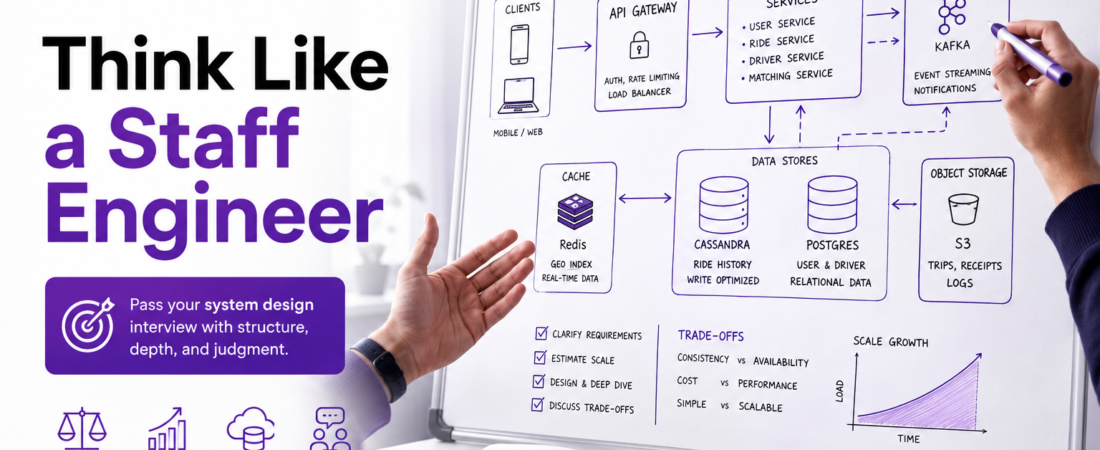
- You need a structured framework: clarify requirements → estimate scale → design high-level → dive deep → discuss trade-offs.
- The biggest mistake candidates make is presenting one “correct” design instead of comparing multiple approaches.
Why the System Design Interview for Staff Engineers Is a Different Beast
At the senior engineer level, the interviewer is checking: can you design a system that works? At the staff level, the bar shifts dramatically.
Staff engineers are expected to make architectural decisions that affect multiple teams and persist for years. The interview simulates that. Interviewers want to see:
- How you handle ambiguity (requirements are always underspecified on purpose)
- Whether you understand the operational cost of your decisions
- How you communicate trade-offs to both technical and non-technical stakeholders
- Whether you can prioritize — you can’t design everything perfectly in 45 minutes
The staff engineer interview is less “design a URL shortener” and more “design a URL shortener and tell me why you wouldn’t use a relational database for the redirect lookup at 10 billion URLs, and what you’d have to give up to make that call.”
[SOURCE: https://www.hellointerview.com/learn/system-design/in-a-hurry/introduction]
Prerequisites
Before you can ace this interview, you need solid foundations in:
- Distributed systems basics: CAP theorem, consistency models, eventual consistency
- Core infrastructure: load balancers, CDNs, databases (SQL vs. NoSQL), message queues (Kafka, SQS)
- Scalability patterns: sharding, caching strategies (write-through, write-around, write-back), read replicas
- Real-world failure modes: thundering herd, hot partitions, cascading failures
If any of those feel shaky, spend two weeks on them before practicing interviews. The framework I describe below won’t help if the technical foundation isn’t there.
Step-by-Step: My System Design Interview Framework
Step 1: Clarify Requirements (5 Minutes — Don’t Skip This)
Every system design prompt is intentionally vague. The first five minutes are not wasted time — they’re a signal to the interviewer that you think before you build.
I always ask the same categories of questions:
- Scale: How many users? Read-heavy or write-heavy? What’s the acceptable latency?
- Consistency: Does every user need to see the same data immediately, or is eventual consistency acceptable?
- Availability: What’s the uptime requirement? 99.9% vs. 99.999% are architecturally different problems.
- Constraints: Any specific tech stack requirements? On-premises or cloud?
I write these down visibly (on the whiteboard or shared doc) and get the interviewer to confirm. This demonstrates structured thinking and ensures you’re solving the right problem.
Step 2: Define the Scale Envelope (5 Minutes)
Back-of-envelope estimation is non-negotiable at the staff level. You don’t need to be exact — you need to establish an order of magnitude.
Example for a ride-sharing app:
Daily active users: 50M
Rides per day: 10M
Rides per second (peak): ~500 RPS (10M / 86400 * 3x peak factor)
Driver location updates: 500 drivers/city × 1000 cities × 1 update/4s = ~125,000 writes/sec
Storage for 1 year of ride data: 10M rides/day × 365 × 1KB = ~3.6 TB
This tells you immediately: you need a write-optimized database for location data, and you need to think about partitioning and replication from the start.
Pro Tip: Write your estimates on the board and narrate them out loud. The interviewer wants to hear your reasoning, not just the final number. Getting within 10x of the right answer with good reasoning is better than a precise answer with no explanation.
Step 3: Design the High-Level Architecture (10 Minutes)
Now draw the boxes. For staff-level interviews, I use a standard layer breakdown:
- Client layer — mobile/web, CDN for static assets
- API Gateway / Load Balancer — routing, rate limiting, auth
- Application services — break into logical domains early (don’t lump everything into “backend”)
- Data layer — separate read path from write path if the scale requires it
- Async layer — message queues for operations that don’t need to be synchronous
At the staff level, you should be making choices at this stage, not just drawing generic boxes. “I’m using a message queue here because driver location updates don’t need to block the ride-matching service” is a staff-level statement.
Step 4: Deep Dive on the Critical Path (15 Minutes)
Choose one or two components and go deep. The interviewer will often guide you, but if they don’t, pick the hardest problem in your design.
For the ride-sharing example, the hardest problems are:
Real-time driver location updates:
- At 125K writes/sec, a traditional SQL database will not survive this load.
- I’d use Redis with geospatial indexing (
GEOADD,GEORADIUS) for in-memory lookups, with an async write-behind to a time-series database (like InfluxDB or Cassandra) for historical data. - Trade-off: Redis is not durable by default. You need to decide if losing a few seconds of location data on a node crash is acceptable. For ride-sharing, it probably is.
Matching algorithm:
- Naive approach: for each ride request, query all nearby drivers. At scale, this becomes O(n) per request.
- Better approach: partition the city into a geohash grid. Each driver updates their geohash cell. Matching queries a cell and its neighbors — constant time.
[SOURCE: https://github.com/donnemartin/system-design-primer]
Step 5: Discuss Trade-Offs Explicitly (10 Minutes)
This is where most candidates fail. They present one design as if it’s the only option. Staff engineers don’t do that.
For every major decision, I explicitly state:
- What I chose and why
- What I gave up
- What would make me choose differently
Example: “I’m using Cassandra for the ride history table because we’re optimizing for write throughput and the query patterns are simple. If we later needed complex ad-hoc analytics — like a data science team running arbitrary SQL — I’d add a data warehouse like Redshift or BigQuery as a read replica, but that adds cost and operational overhead, so I’d hold off until there’s a concrete use case.”
That’s a staff-level answer. Senior engineers say “use Cassandra.” Staff engineers say “use Cassandra, and here’s when you’d stop using it.”
Real-World Tips I Used to Pass
With the framework in place, these four habits were what actually separated my passing attempts from my failing ones.
Tip 1: Practice narrating, not just drawing. The whiteboard is evidence of your thinking, not a substitute for it. I practiced out loud, alone, 30 minutes a day for six weeks. It felt ridiculous — it worked.
Tip 2: Know your failure modes. For every component you add, be ready to say what happens when it fails. “If the Redis cache goes down, read traffic falls back to the database — which would then be overwhelmed, so I’d add a circuit breaker.” This shows production experience.
Tip 3: Reference real systems. Casually mentioning “this is similar to how DynamoDB handles hot partitions with adaptive capacity” signals that you’ve engaged with real engineering writing, not just textbook definitions. Read AWS, Google, and Netflix engineering blog posts.
Tip 4: Drive the conversation. Don’t wait for the interviewer to prompt you. Say “I’m going to spend the next ten minutes on the data model — let me know if you’d rather I go somewhere else first.” This demonstrates staff-level ownership.
Common Mistakes and How I Fixed Them
These weren’t hypothetical slip-ups — I made every one of them before I understood what the staff bar actually required.
Mistake: Jumping to a solution before clarifying requirements. Fix: I made it a rule to spend the first five minutes asking questions, no matter how obvious the problem seemed. I literally set a mental timer.
Mistake: Designing for infinite scale from the start. Fix: I stopped proposing Kubernetes, Kafka, and multi-region replication for every problem. For a startup with 10K users, a monolith on a single Postgres database is the right answer. I learned to design for the stated scale, then explain how I’d evolve it.
Mistake: Avoiding trade-off discussions because I didn’t want to sound uncertain. Fix: I reframed trade-offs as strength, not weakness. Saying “I’m not sure this is the best approach for X reason” shows engineering maturity. Interviewers at the staff level are specifically looking for intellectual honesty.
FAQ
How long should a staff engineer system design interview answer be?
Most staff-level system design interviews are 45–60 minutes. You should spend roughly 5 minutes on requirements, 5 on estimation, 10 on high-level design, 15 on deep dives, and 10 on trade-offs and follow-up questions. Don’t rush — the quality of your reasoning matters more than how many components you cover.
What’s the difference between a senior and staff engineer system design interview?
Senior interviews evaluate whether you can design a system that works. Staff interviews evaluate whether you can make the right architectural decisions under ambiguity, communicate trade-offs clearly, and lead a technical direction that others will build on. Interviewers at the staff level will push back on your choices — the ability to defend or revise your design under pressure is part of the test.
How do I practice system design for a staff engineer interview on my own?
Read real engineering blogs (AWS Architecture Blog, Netflix Tech Blog, Uber Engineering) and reverse-engineer their design decisions. For each system they describe, ask: what problem were they solving? What did they trade off? Then practice explaining those decisions out loud in under 10 minutes.
What system design topics come up most often in staff engineer interviews?
In my experience, the most common topics are: distributed databases and consistency models, real-time data pipelines (event streaming), caching strategies and invalidation, API design and rate limiting, and search systems. These apply to most product verticals, so they’re interviewer favorites.
How should I handle it if I don’t know a specific technology the interviewer mentions?
Say so directly: “I haven’t worked with X specifically, but based on what you’re describing, it sounds like it serves a similar purpose to Y, which I’ve used to solve Z.” Never bluff. Interviewers know their own systems better than you do, and getting caught guessing is worse than admitting a knowledge gap.
Conclusion
Passing the system design interview for staff engineer roles isn’t about knowing more technology — it’s about demonstrating judgment, structure, and intellectual honesty. The framework I’ve described — clarify, estimate, design, deep dive, trade-offs — is not a script. It’s a signal that you think the way staff engineers think.
The biggest shift for me was accepting that a design with well-articulated trade-offs beats a “perfect” design with no self-awareness. There is no perfect design. There are only decisions, and the reasoning behind them.
If you found this useful, share it with someone prepping for their next interview — and leave a comment with the topic you find hardest to prepare for. I read every one.
About the Author
I’m a staff engineer with 11 years in the industry, currently working on distributed data infrastructure. My stack includes Go, Kafka, Postgres, and Kubernetes, and I’ve conducted over 80 system design interviews across two companies. I write about engineering career growth because the path from senior to staff is genuinely under-documented, and I want to change that.