
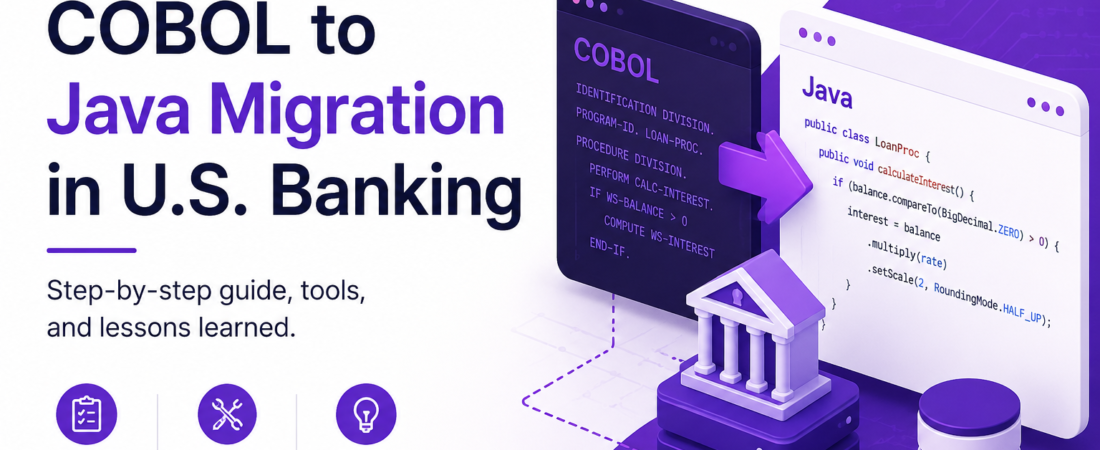
Meta Description: I walked a U.S. bank through a full COBOL-to-Java migration — here’s the exact process, tooling, and lessons learned that saved us six months of rework.
Last updated: June 2026
Introduction
The first time I stared at 40,000 lines of COBOL running a core lending system at a mid-sized U.S. bank, I felt the weight of five decades of business logic staring back at me. There were no unit tests. Comments were sparse. Variable names like WS-TRANS-AMT-9V2 were generous by the standards of the codebase. Management wanted it gone — migrated to Java — in 18 months.
This guide covers the exact COBOL-to-Java migration process I used, what nearly broke us, and how I’d do it differently today. If you’re responsible for a banking modernization program, this is the playbook I wish I’d had from day one.
TL;DR
- COBOL-to-Java migration in banking is not a rewrite — it’s a semantic translation that requires deep business logic discovery before a single Java class is written.
- Use strangler fig pattern + integration testing at the data layer to de-risk each module incrementally.
- Automated transpilers help but always produce code that needs significant human cleanup — plan for it.
Why COBOL Migration Matters Right Now
U.S. banks collectively run an estimated 95% of ATM transactions and 80% of in-person credit card transactions on COBOL systems. The problem is no longer theoretical: the developer pool is shrinking fast, and regulators are starting to flag legacy infrastructure as operational risk.
Legacy COBOL modernization has become a board-level conversation. Java is the most common migration target because of its mature ecosystem, strong typing, and JVM performance — all attributes that map well to the reliability demands of financial systems.
[INTERNAL LINK: related article on microservices for financial systems]
Prerequisites
Before you write a single line of Java, make sure you have:
- Access to a COBOL static analysis tool (I used Micro Focus Enterprise Analyzer; IBM ADDI is also excellent)
- A complete inventory of batch jobs, CICS transactions, and JCL scripts — every entry point matters
- A dedicated environment mirroring production data schemas (anonymized)
- A Java architect with JEE or Spring Boot experience — not just a backend generalist
- Business analysts who can validate functional equivalence, because developers cannot do this alone
[SOURCE: https://www.ibm.com/products/application-discovery-and-delivery-intelligence]
Step-by-Step: How to Migrate COBOL to Java in a Banking Environment
Step 1: Audit and Catalog the COBOL Codebase
The first and most critical step is understanding what you actually have. I ran Micro Focus Enterprise Analyzer against the full source tree and generated a call graph and data dependency map. This revealed 14 “dead” programs — COBOL modules that were no longer called by anything — that no one on the team knew existed.
Export every copybook (.cpy files are COBOL’s equivalent of shared data structures). These will become your Java POJOs or record classes later. Document each program’s:
- Input/output files and their layouts
- DB2 or VSAM data sources
- External system calls (MQ, CICS, batch schedulers)
bash
# Example: running Micro Focus EA from CLI to export call graph
mfea-analyze --source ./cobol/src --output ./reports/callgraph.json --format json
Step 2: Prioritize Modules by Risk and Business Value
Not everything should migrate at the same time. I built a 2×2 matrix: complexity vs. business criticality. High-complexity, low-criticality modules (old report generators, for example) were candidates for decommission, not migration. High-criticality, low-complexity modules went first — they gave the team early wins and validated our testing harness.
We used the strangler fig pattern: keep the COBOL system running, and route specific transactions to the new Java service once it passes equivalence testing. This avoids a risky big-bang cutover.
Step 3: Set Up the Java Project Structure
We chose Spring Boot 3.x as the foundation. The project structure mapped deliberately to COBOL concepts:
/src
  /main/java
    /com/bank/lending
      /batch         ← replaces COBOL batch JCL jobs
      /service       ← business logic from PROCEDURE DIVISION
      /domain        ← POJOs from COBOL WORKING-STORAGE copybooks
      /integration   ← DB2, MQ, and CICS adapters
  /test
    /java
      /com/bank/lending
        /equivalence   ← side-by-side output comparison tests
This structure made code reviews easier — any developer could trace a COBOL program to its Java counterpart by folder name.
Step 4: Translate Data Structures First
COBOL’s WORKING-STORAGE SECTION and copybooks are your data contracts. Translate these before any logic. A COBOL PIC 9(7)V99 (a packed decimal with 7 integer digits and 2 decimal places) maps to Java’s BigDecimal — never double or float in financial code.
java
// COBOL: 05 WS-LOAN-BALANCE PIC 9(9)V99.
// Java equivalent:
private BigDecimal loanBalance; // Always BigDecimal for monetary values

// COBOL: 05 WS-EFFECTIVE-DATE PIC 9(8). (YYYYMMDD)
// Java equivalent:
private LocalDate effectiveDate;
I made the mistake early on of letting a junior dev use double for interest calculations. The rounding errors were invisible in unit tests but surfaced in reconciliation. Use BigDecimal everywhere money is involved — this is non-negotiable.
Step 5: Translate Business Logic with Equivalence Tests
This is the hardest step. COBOL’s PERFORM statements, EVALUATE (switch/case), and COMPUTE arithmetic translate reasonably well to Java, but the implied decimal scaling and REDEFINES clauses (where one memory area is interpreted as multiple data types) are landmines.
For each module I migrated, I wrote an equivalence test that fed the same input to both the COBOL system (via a thin wrapper) and the Java service, then compared output byte-for-byte:
java
@Test
void loanCalculation_shouldMatchCobolOutput() {
    CobolLoanResult cobolResult = cobolRunner.execute("LOAN001", testInput);
    JavaLoanResult javaResult = loanService.calculate(testInput);

    assertThat(javaResult.getMonthlyPayment())
        .isEqualByComparingTo(cobolResult.getMonthlyPayment());
    assertThat(javaResult.getEffectiveDate())
        .isEqualTo(cobolResult.getEffectiveDate());
}
I ran these in CI on every commit. Any divergence stopped the pipeline.
Step 6: Handle DB2 and File I/O Migration
Most banking COBOL systems use IBM DB2 or VSAM flat files. DB2 maps naturally to Spring Data JPA or plain JDBC — we kept DB2 as the database during migration to eliminate a variable.
VSAM files were the real challenge. We wrote Spring Batch jobs that read VSAM exports via a custom ItemReader and replicated the original batch semantics:
java
@Bean
public FlatFileItemReader<LoanRecord> vsamLoanReader() {
    return new FlatFileItemReaderBuilder<LoanRecord>()
        .name("loanReader")
        .resource(new FileSystemResource("/data/loans/LOANMAST.DAT"))
        .fixedLength()
        .columns(new Range[]{new Range(1,9), new Range(10,18), new Range(19,26)})
        .names("accountId", "balance", "effectiveDate")
        .targetType(LoanRecord.class)
        .build();
}
Real-World Tips I Use in Production
Use automated transpilers as a first draft, not a final answer. Tools like BlueAge or AWS Mainframe Modernization can generate Java from COBOL automatically. The output compiles, but it reads like machine-generated code — because it is. I use it to understand logic flow, then rewrite the Java by hand.
Freeze the COBOL codebase during migration. If the source keeps changing, your equivalence tests chase a moving target. Negotiate a feature freeze with the business for each module before migration starts.
Log everything at the boundary. Every call into the Java service from the strangler proxy should log inputs and outputs. When something breaks in production, this is the diff that saves you.
Pro Tip: Map COBOL
RETURN-CODEvalues to Java custom exceptions early. Most COBOL programs signal errors via a return code convention that will be invisible if you don’t explicitly model it in your Java exception hierarchy.
Common Errors and How I Fixed Them
Error: Decimal rounding mismatch in interest calculations
COBOL uses ROUNDED clause semantics that default to half-up rounding. Java’s BigDecimal.divide() throws ArithmeticException on non-terminating decimals by default. Fix: always specify RoundingMode.HALF_UP explicitly.
java
BigDecimal monthlyRate = annualRate.divide(BigDecimal.valueOf(12), 10, RoundingMode.HALF_UP);Error: Date arithmetic off by one
COBOL dates in PIC 9(8) format (YYYYMMDD) sometimes used legacy “century window” logic where years 00–49 mean 2000–2049. I had to write a custom CobolDateConverter that replicated this window.
Error: Spring Batch job hangs on large VSAM files
VSAM exports could be 2GB+. Reading them with default chunk size caused OOM errors. Fix: set chunk size to 500 records and enable restart capability via JobRepository.
[SOURCE: https://docs.spring.io/spring-batch/docs/current/reference/html/]
FAQ
How long does a COBOL-to-Java banking migration actually take?
In my experience, a mid-sized system with 500,000–1,000,000 lines of COBOL takes 18–36 months when using an incremental strangler fig approach. Big-bang rewrites take less calendar time but carry exponentially higher risk — I’ve never seen one succeed in a regulated banking environment without at least one production incident.
Should I use automated COBOL-to-Java transpilers or rewrite by hand?
Both, strategically. I use transpilers (BlueAge, AWS Mainframe Modernization) to generate a first-pass translation that helps the team understand the logic. Then I rewrite modules by hand to produce maintainable, idiomatic Java. Transpiled code is technically correct but nearly unmaintainable.
How do I handle COBOL REDEFINES clauses in Java?
REDEFINES allows one memory buffer to be interpreted as different data types — it’s essentially a C-style union. In Java, model these with a sealed class hierarchy or a wrapper that exposes multiple typed views of the same byte buffer using ByteBuffer. It’s verbose but correct.
What are the biggest regulatory risks in a COBOL-to-Java banking migration?
The biggest risks are functional non-equivalence (the Java system computes different results), audit trail gaps (COBOL batch jobs often write directly to audit files), and change management failures. Work with your compliance team early. Every migrated module should pass a formal UAT sign-off before cutover.
Is Kotlin a better migration target than Java for banking COBOL systems?
Kotlin is compelling for new development, but for COBOL migration I stick with Java. The target audience — enterprise banking teams — has deeper Java expertise, and Java’s verbosity actually helps when translating from COBOL’s explicit data declarations. Kotlin’s null safety and concise syntax are nice, but they add cognitive overhead during an already complex migration.
Conclusion
Migrating COBOL to Java in a U.S. banking context is one of the most technically and organizationally complex projects a development team can undertake. The code is the easy part — the hard parts are discovering undocumented business logic, building equivalence test infrastructure, and convincing stakeholders to trust a system they can’t see running on a mainframe anymore.
If this article helped you think through your migration roadmap, I’d love to hear your specific challenges in the comments. And if you’re just starting out, bookmark this and share it with your architect — it’ll save you at least one painful rework cycle.
About the Author
I’m a senior software engineer with over 12 years of experience in financial systems modernization, with a focus on Java, Spring Boot, and mainframe migration. I’ve led COBOL migration programs at three U.S. financial institutions and currently consult on legacy modernization strategy for regulated industries. My primary stack includes Java 21, Spring Batch, DB2, and AWS — but I still keep a COBOL reference on my shelf.