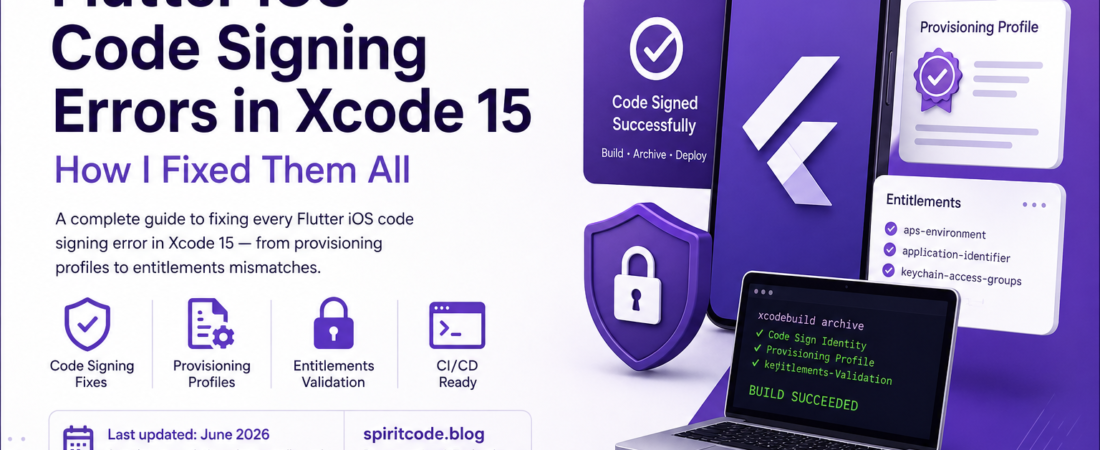
Meta description: I spent two days debugging Flutter iOS code signing errors after upgrading to Xcode 15. Here’s every fix I found — from provisioning profiles to entitlements mismatches.
Last updated: June 2026
Introduction
The day I upgraded to Xcode 15, my Flutter app refused to build for iOS. The error was cryptic: errSecInternalComponent buried under a wall of red in the Xcode logs. I’d touched nothing in the project — same code, same certificates, same provisioning profiles. Yet everything broke.
After two days of digging through Apple forums, Flutter GitHub issues, and Stack Overflow threads with zero accepted answers, I finally pieced together what changed in Xcode 15 and how to fix each failure mode. This guide covers every Flutter iOS code signing error I encountered, in the order I encountered them.
TL;DR
- Xcode 15 changed how it resolves provisioning profiles and codesign entitlements, breaking existing Flutter CI/CD pipelines and local builds.
- The most common culprits are: expired or mismatched signing certificates, missing
DEVELOPMENT_TEAMinproject.pbxproj, and Xcode 15’s new strict entitlement validation. - Manual signing with explicit certificate fingerprints is the most reliable fix for CI environments.
Why This Matters
Flutter iOS code signing has always been finicky, but Xcode 15 raised the stakes. Apple introduced stricter validation of entitlements against your provisioning profile, tightened keychain access during automated builds, and deprecated some signing workflows that Flutter’s toolchain relied on silently.
If you’re on a team shipping Flutter apps to the App Store or TestFlight, these errors will block your entire release pipeline. And since Xcode 15 ships with macOS Sonoma, upgrading your Mac can trigger this without warning.
[SOURCE: https://developer.apple.com/documentation/xcode-release-notes/xcode-15-release-notes]
Prerequisites
Before diving in, make sure you have:
- Flutter 3.16+ (run
flutter upgradeif unsure) - Xcode 15.x installed (
xcodebuild -versionto confirm) - An Apple Developer account with active certificates
- Access to your
ios/Runner.xcworkspaceandios/Runner.xcodeproj/project.pbxproj
Step-by-Step: Fixing Flutter iOS Code Signing in Xcode 15
Step 1: Verify Your Signing Certificate Is Valid
The first thing I check is whether the signing certificate is actually valid and trusted in the keychain.
# List all valid code signing identities
security find-identity -v -p codesigning
If you see 0 valid identities found or your certificate shows CSSMERR_TP_CERT_REVOKED, you need to revoke and regenerate it from the Apple Developer portal.
A common Xcode 15 gotcha: even if the cert looks valid in Keychain Access, the private key might be missing. Look for a disclosure triangle next to the certificate — if there’s no private key underneath it, you need to re-import the .p12 file.
# Import a .p12 certificate into the login keychain
security import MyCert.p12 -k ~/Library/Keychains/login.keychain-db -P "your-password" -T /usr/bin/codesign
Step 2: Fix the DEVELOPMENT_TEAM in project.pbxproj
Xcode 15 is much stricter about requiring the DEVELOPMENT_TEAM to be explicitly set in the project file. If you use automatic signing, this sometimes gets cleared during flutter create or when regenerating the iOS project.
Open ios/Runner.xcodeproj/project.pbxproj in any text editor and search for DEVELOPMENT_TEAM. You should see it under both Debug and Release build configurations:
DEVELOPMENT_TEAM = XXXXXXXXXX;
Replace XXXXXXXXXX with your actual 10-character Team ID, found in the Apple Developer portal under Membership.
If it’s blank or missing entirely, Xcode 15 throws a signing error even if automatic signing is enabled in the UI.
Step 3: Resolve Provisioning Profile Mismatches
Provisioning profile mismatches are the most common source of errSecInternalComponent errors in Xcode 15. Run this to see what profiles are currently installed:
# List all locally installed provisioning profiles
ls ~/Library/MobileDevice/Provisioning\ Profiles/
Then check what your project is actually requesting:
# Find provisioning profile UUID referenced in the project
grep -r "PROVISIONING_PROFILE_SPECIFIER" ios/Runner.xcodeproj/project.pbxproj
If those UUIDs don’t match any installed profile, download the correct one from the Apple Developer portal and double-click to install it. In my case, the profile had been auto-renewed by Apple but the UUID changed — Xcode 15 doesn’t silently fall back the way Xcode 14 did.
Pro Tip: Use
security cms -D -i /path/to/profile.mobileprovisionto decode a provisioning profile and inspect its entitlements, expiry date, and certificate fingerprints without opening Xcode.
Step 4: Fix Entitlement Validation Errors (Xcode 15-Specific)
This is the new failure mode that Xcode 15 introduced. Even if your signing chain is valid, Xcode 15 now validates that every entitlement in your Runner.entitlements file is explicitly listed in the provisioning profile.
Check your entitlements file at ios/Runner/Runner.entitlements. A typical Flutter app might have:
<?xml version="1.0" encoding="UTF-8"?>
<!DOCTYPE plist PUBLIC "-//Apple//DTD PLIST 1.0//EN" "http://www.apple.com/DTDs/PropertyList-1.0.dtd">
<plist version="1.0">
<dict>
    <key>aps-environment</key>
    <string>development</string>
</dict>
</plist>
If aps-environment (push notifications) is in your entitlements but your provisioning profile doesn’t include the Push Notifications capability, Xcode 15 will reject the build. Fix this in the Apple Developer portal by editing the App ID and enabling the missing capability, then regenerating and re-downloading the provisioning profile.
[SOURCE: https://github.com/flutter/flutter/issues/135099]
Step 5: Configure Manual Signing for CI/CD
Automatic signing breaks in CI environments because the system keychain doesn’t have the signing identity unlocked. I switched to manual signing after losing hours to xcodebuild errors on GitHub Actions.
In your ios/Runner.xcodeproj/project.pbxproj, set:
CODE_SIGN_STYLE = Manual;
PROVISIONING_PROFILE_SPECIFIER = "match AppStore com.yourapp.bundle";
CODE_SIGN_IDENTITY = "iPhone Distribution";
Then in your CI pipeline, unlock the keychain before building:
# Unlock keychain for codesign access during CI
security unlock-keychain -p "$KEYCHAIN_PASSWORD" ~/Library/Keychains/login.keychain-db
security set-keychain-settings -t 3600 -l ~/Library/Keychains/login.keychain-db

# Build with explicit signing settings
xcodebuild -workspace ios/Runner.xcworkspace \
  -scheme Runner \
  -configuration Release \
  -archivePath build/Runner.xcarchive \
  CODE_SIGN_STYLE=Manual \
  DEVELOPMENT_TEAM="$TEAM_ID" \
  PROVISIONING_PROFILE_SPECIFIER="$PROFILE_NAME" \
  archive
Real-World Tips I Use in Production
Always pin your Xcode version in CI. I use xcodes to manage multiple Xcode versions and reference the exact version in my CI config. An unexpected Xcode upgrade is how most signing pipelines break.
Separate certificates for Debug and Release. In my project.pbxproj, I explicitly set different CODE_SIGN_IDENTITY values for Debug (iPhone Developer) and Release (iPhone Distribution). This avoids accidental cross-configuration signing issues that Xcode 15 now flags as errors.
Regenerate your iOS project if all else fails. Run flutter clean && rm -rf ios && flutter create . --platforms=ios to regenerate a clean iOS folder. You’ll need to re-add your entitlements and custom build settings, but it eliminates any corrupted state in project.pbxproj.
Common Errors and How I Fixed Them
error: No signing certificate "iOS Distribution" found Your distribution certificate isn’t in the keychain. Re-import the .p12 from the Apple Developer portal or from a team member who exported it.
errSecInternalComponent during archive This almost always means codesign can’t access the private key. Run security unlock-keychain before building, or try signing with allow-any-certificate:
security set-key-partition-list -S apple-tool:,apple: -s -k "$KEYCHAIN_PASSWORD" ~/Library/Keychains/login.keychain-db
Provisioning profile doesn't include the aps-environment entitlement Xcode 15 strict entitlement validation. Enable the Push Notifications capability in your App ID on the developer portal, regenerate the profile, and re-download.
Flutter build ios works but xcodebuild archive fails Check if flutter build ios is using a different keychain or signing identity than xcodebuild. Run flutter build ios --verbose and compare the codesign invocations.
FAQ
Q: Why did my Flutter iOS build break after upgrading to Xcode 15 without changing any code? A: Xcode 15 introduced stricter entitlement validation and changed how it resolves provisioning profiles. Profiles that worked silently in Xcode 14 may now fail if there are entitlement mismatches or if the provisioning profile UUID changed during Apple’s automatic renewal cycle.
Q: How do I fix Flutter iOS code signing errors in GitHub Actions after switching to Xcode 15? A: The most reliable approach is to create a temporary keychain, import your .p12 certificate into it, unlock it before the build, and use manual signing with explicit CODE_SIGN_IDENTITY and PROVISIONING_PROFILE_SPECIFIER values in your xcodebuild command.
Q: What does the errSecInternalComponent error mean in Flutter Xcode builds? A: It means the codesign tool can’t access the private key for your signing certificate. This usually happens in CI because the keychain is locked. Unlock it with security unlock-keychain and grant codesign access with security set-key-partition-list.
Q: How do I check which provisioning profile Flutter is using to sign my iOS app? A: Open ios/Runner.xcodeproj/project.pbxproj in a text editor and search for PROVISIONING_PROFILE_SPECIFIER. You can also run xcodebuild -showBuildSettings from the ios/ directory to see the resolved signing settings for the current configuration.
Q: Can I use Fastlane Match to fix Flutter iOS code signing errors in Xcode 15? A: Yes, and I highly recommend it for teams. Fastlane Match manages certificates and provisioning profiles in a git repo, ensures everyone uses the same signing identity, and works well with Xcode 15’s stricter validation. Run bundle exec fastlane match appstore to sync and install the correct profiles automatically.
Conclusion
Flutter iOS code signing errors in Xcode 15 are painful, but they’re fixable once you understand what changed. The key insight is that Xcode 15 is stricter — about entitlements, about keychain access, about provisioning profile resolution — so workflows that worked through silent fallbacks in Xcode 14 now fail loudly.
Start with certificate validity, check your DEVELOPMENT_TEAM, validate your provisioning profiles, and move to manual signing for CI. That sequence resolved every error I hit.
About the Author
I’m a senior mobile engineer with over 8 years of experience shipping iOS and Android apps, and I’ve been building with Flutter since its 1.0 release. My stack includes Flutter, Dart, Swift, and Fastlane for CI/CD. I’ve managed App Store releases for consumer apps with millions of users, which means I’ve spent more time than I’d like to admit debugging Xcode signing pipelines.