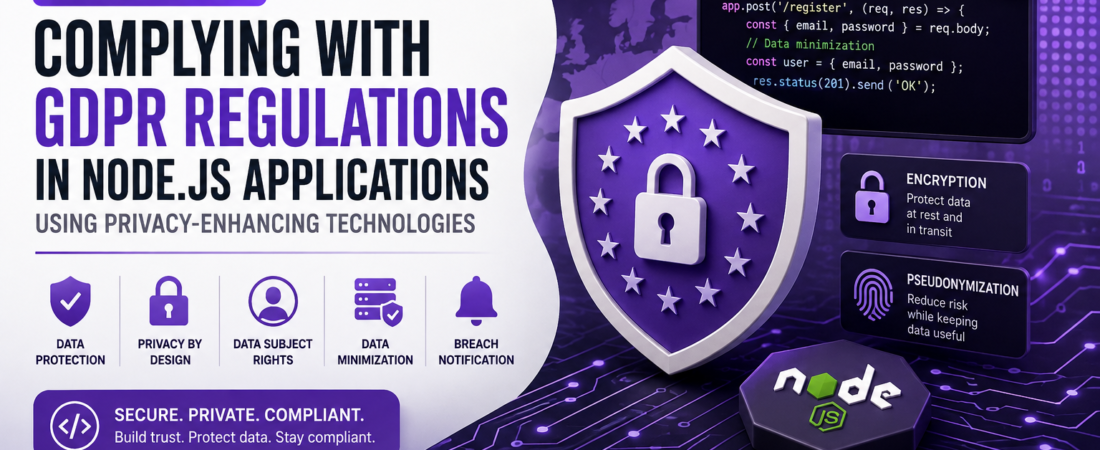
Learn how to ensure GDPR compliance in Node.js applications using privacy-enhancing technologies
# Complying with GDPR Regulations in Node.js Applications Using Privacy-Enhancing Technologies
As a senior software engineer, I’ve recently found myself dealing with the complex task of ensuring GDPR compliance in our company’s Node.js applications. The General Data Protection Regulation (GDPR) is a comprehensive data protection framework that imposes strict obligations on organizations that collect and process personal data of EU residents. Ensuring GDPR compliance is crucial to avoid hefty fines and maintain customer trust.
## What Are the Key GDPR Requirements for Node.js Applications?
When it comes to GDPR compliance in Node.js applications, there are several key requirements that we need to focus on. These include data minimization, data protection by design and by default, data subject rights, and data breach notification. In this section, we’ll explore each of these requirements in detail and discuss how we can implement them in our Node.js applications.
### How Do I Implement Data Minimization in My Node.js Application?
Data minimization is a fundamental principle of GDPR that requires us to only collect and process the minimum amount of personal data necessary to achieve our purposes. To implement data minimization in our Node.js application, we need to review our data collection practices and ensure that we’re only collecting the data that’s strictly necessary. For example, if we’re building a user registration system, we might only need to collect the user’s email address and password, rather than their full name, address, and phone number.
“`javascript
// Example of data minimization in a user registration system
const express = require(‘express’);
const app = express();
app.post(‘/register’, (req, res) => {
const { email, password } = req.body;
// Only store the email and password in the database
const user = { email, password };
// …
});
“`
## How Do I Use Privacy-Enhancing Technologies to Ensure GDPR Compliance?
Privacy-enhancing technologies (PETs) are a set of technologies that can help us protect personal data and ensure GDPR compliance. Some examples of PETs include encryption, pseudonymization, and anonymization. In this section, we’ll explore how we can use these technologies in our Node.js applications.
### What Is Encryption and How Does It Help with GDPR Compliance?
Encryption is a PET that involves converting plaintext data into unreadable ciphertext to protect it from unauthorized access. To encrypt data in our Node.js application, we can use a library like `crypto`. For example:
“`javascript
// Example of encrypting data using the crypto library
const crypto = require(‘crypto’);
const encrypt = (data) => {
const iv = crypto.randomBytes(16);
const cipher = crypto.createCipheriv(‘aes-256-cbc’, ‘secret key’, iv);
const encrypted = Buffer.concat([cipher.update(data), cipher.final()]);
return iv.toString(‘hex’) + ‘:’ + encrypted.toString(‘hex’);
};
“`
> **Pro Tip:** When using encryption, make sure to store the encryption keys securely and use a secure protocol for key exchange.
## How Do I Handle Data Subject Rights in My Node.js Application?
Data subject rights are a critical aspect of GDPR compliance. These rights include the right to access, rectify, erase, restrict, and object to processing of personal data. To handle data subject rights in our Node.js application, we need to implement APIs that allow users to exercise these rights. For example:
“`javascript
// Example of handling data subject rights using APIs
const express = require(‘express’);
const app = express();
app.get(‘/users/:id’, (req, res) => {
const id = req.params.id;
// Return the user’s data in a machine-readable format
const userData = { /* user data */ };
res.json(userData);
});
app.put(‘/users/:id’, (req, res) => {
const id = req.params.id;
const updates = req.body;
// Update the user’s data
// …
});
app.delete(‘/users/:id’, (req, res) => {
const id = req.params.id;
// Delete the user’s data
// …
});
“`
> **Pro Tip:** When handling data subject rights, make sure to authenticate and authorize the user before processing their request.
## FAQ
### What Is the Difference Between Data Protection by Design and Data Protection by Default?
Data protection by design and data protection by default are two related but distinct concepts in GDPR. Data protection by design refers to the practice of designing systems and processes with data protection in mind from the outset. Data protection by default, on the other hand, refers to the practice of setting default settings and configurations that protect personal data.
### How Do I Conduct a Data Protection Impact Assessment (DPIA) for My Node.js Application?
A DPIA is a process that helps us identify and mitigate the risks associated with processing personal data. To conduct a DPIA for our Node.js application, we need to follow a structured approach that involves identifying the processing activities, assessing the risks, and implementing measures to mitigate those risks.
### What Are the Consequences of Non-Compliance with GDPR in Node.js Applications?
The consequences of non-compliance with GDPR can be severe, including fines of up to €20 million or 4% of the organization’s global turnover. Additionally, non-compliance can damage our reputation and erode customer trust.
### How Do I Ensure GDPR Compliance in Third-Party Libraries and Dependencies?
To ensure GDPR compliance in third-party libraries and dependencies, we need to carefully review their data processing practices and ensure that they align with our GDPR obligations. We should also include GDPR-related clauses in our contracts with third-party vendors.
### Can I Use Cloud Services to Ensure GDPR Compliance in My Node.js Application?
Yes, cloud services can help us ensure GDPR compliance in our Node.js application. Many cloud providers offer GDPR-compliant services and tools that can help us meet our GDPR obligations. However, we still need to ensure that we’re using these services in a way that’s consistent with GDPR requirements.
## Conclusion
Ensuring GDPR compliance in Node.js applications is a complex task that requires careful attention to detail and a deep understanding of the GDPR requirements. By using privacy-enhancing technologies, handling data subject rights, and ensuring data protection by design and by default, we can build Node.js applications that meet the highest standards of data protection. Remember, GDPR compliance is an ongoing process that requires continuous monitoring and improvement. As a developer, it’s our responsibility to ensure that our applications are GDPR-compliant and that we’re protecting our users’ personal data.
Follow SpiritCode for more posts on building secure and compliant Node.js applications.