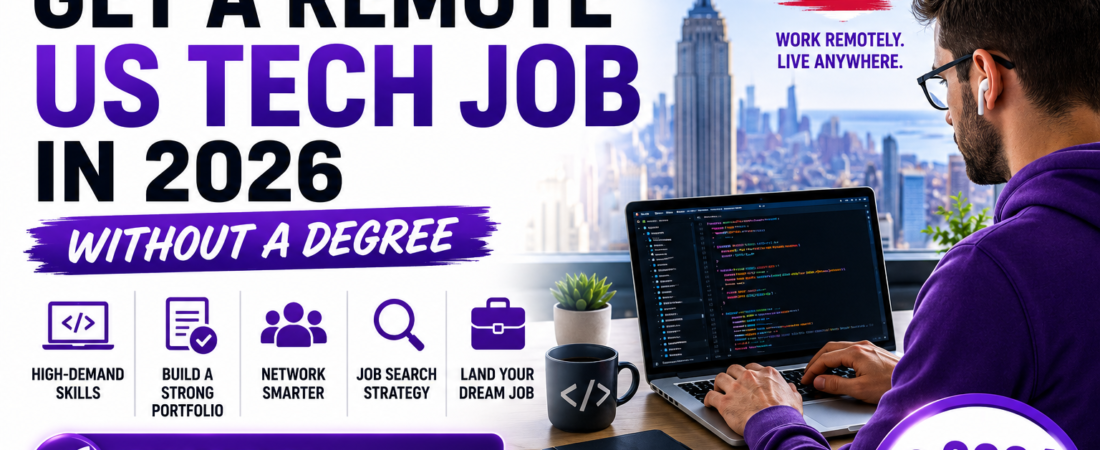
Meta Description: A realistic, step-by-step roadmap to landing a remote US tech job in 2026 without a degree — skills, portfolio, networking, and job search strategy.
I want to be upfront about something before we go any further: this article isn’t going to tell you that you’ll land a remote six-figure job in three months by grinding a coding bootcamp on weekends. That narrative sells courses, but in my experience, it sets people up to quit right before things start working. What I can tell you is that getting a remote US tech job without a degree is genuinely possible in 2026 — I’ve seen it happen, and I’ve hired people who did exactly this — but it takes a specific combination of skill, proof of work, and a job search strategy most people skip.
This is the roadmap I’d actually give someone starting from zero today.
Is It Still Possible to Get a Tech Job Without a Degree in 2026?
Yes, but the bar has moved. A few years ago, showing up with a GitHub profile and enthusiasm was often enough for an entry-level role. Today, with more competition and companies being more selective after several rounds of industry layoffs, you need to demonstrate real, applied skill — not just completed tutorials. The good news: companies still care far more about what you can build and ship than about where you went to school, especially for remote roles at startups and mid-size companies.
Why “No Degree” Doesn’t Mean “No Requirements”
Skipping a degree doesn’t mean skipping the work — it means redirecting the same effort toward things that actually get you hired: a portfolio that proves competence, a narrow specialization employers are actively searching for, and a job search process that gets you in front of the right people. Here’s what I mean by not applying to jobs.
Phase 1: Pick a Specialization (Don’t Try to Learn Everything)
One of the biggest mistakes I see self-taught developers make is trying to learn a little bit of everything — some frontend, some backend, a bit of data science, a bit of DevOps — and ending up without a strong signal in any direction. Employers hiring without a degree requirement are looking for depth as a substitute for credentials.
Pick one of these paths and commit to it for at least 6 months:
- Frontend development (React, TypeScript, modern CSS)
- Backend development (Node.js, Python/Django, or Go)
- Full-stack (a combination, but with a clear primary strength)
- DevOps / Cloud (AWS or Azure fundamentals, Docker, CI/CD)
- QA Automation (often an easier entry point with strong remote demand)
I’d lean toward full-stack or backend if you’re unsure, since they tend to have the broadest number of open remote roles.
Phase 2: Build a Portfolio That Proves Skill, Not Just Effort
A portfolio of five tutorial clones (another to-do app, another weather app) doesn’t differentiate you. What does is one or two projects that solve a real, specific problem and are built to a production-quality standard.
Here’s the standard I hold my own portfolio projects to, and what I look for when reviewing candidates:
- Deployed and accessible — not just code sitting in a repo, but a live URL someone can actually use
- Tested — at least basic unit or integration tests, showing you understand quality beyond “it works on my machine”
- Documented — a clear README explaining the problem, the stack, and setup instructions
- Uses real-world patterns — authentication, a real database, error handling, environment configuration
- Solves an actual problem — even something small, like a tool that scrapes and summarizes local job listings, is more compelling than a generic clone
One well-built project that you can talk through in detail during an interview is worth more than ten shallow ones.
Phase 3: Get Comfortable with the Tools Remote Teams Actually Use
Remote tech jobs assume async-first collaboration. Beyond your core programming skills, make sure you’re comfortable with:
- Git and GitHub (branching, pull requests, code review etiquette)
- Basic CI/CD concepts (what a pipeline does, why tests run automatically)
- Written communication (clear async updates, documentation)
- A project management tool (Jira, Linear, or similar)
- Video call etiquette and async standups
I’ve seen technically strong candidates struggle in remote roles simply because they weren’t used to communicating asynchronously and clearly in writing. This is a skill you can practice now, before you’re being evaluated on it.
Phase 4: Network Before You Need To
Cold applications through job boards have a notoriously low response rate — in my experience, often under 2%. Referrals and warm introductions perform dramatically better. Start building visibility before you’re actively job hunting:
- Share what you’re building on X/Twitter or LinkedIn as you go, not just the finished product
- Contribute to open-source projects in your specialization — even small documentation fixes count
- Join communities specific to your stack (Discord servers, subreddits, local meetups if available)
- Engage genuinely with other developers’ posts instead of only self-promoting
This isn’t about gaming an algorithm. It’s about becoming a known, visible person in your niche before a hiring manager ever sees your resume.
Phase 5: The Job Search Itself
Once you have a specialization and a portfolio you’re proud of, the search process looks like this:
- Target company size deliberately. Startups and mid-size companies are typically more open to skipping degree requirements than large enterprises with rigid HR filters.
- Apply within 48 hours of a posting going live. Response rates drop sharply after the first few days.
- Customize your resume’s top third for each role, mirroring the language in the job description (this also helps with applicant tracking systems).
- Reach out directly to the hiring manager or team lead on LinkedIn with a short, specific message referencing the role — not a generic “I’d love to connect.”
- Track everything. A simple spreadsheet of applications, dates, and follow-ups keeps you from losing momentum.
Common Mistakes I See Self-Taught Developers Make
| Mistake | Why It Hurts You | What to Do Instead |
|---|---|---|
| Learning too many technologies shallowly | No clear signal of expertise | Go deep in one specialization for 6+ months |
| Only building tutorial-clone projects | Doesn’t demonstrate independent problem-solving | Build 1-2 original projects solving real problems |
| Applying only through job boards | Extremely low response rate | Combine applications with direct outreach and networking |
| Waiting until “ready” to start networking | Misses months of visibility-building | Start sharing progress publicly from day one |
| No tests, no deployment, no docs | Signals tutorial-level skill, not production skill | Treat every portfolio project like real production code |
| Ignoring soft/communication skills | Remote teams rely heavily on async writing | Practice clear written updates and documentation |
Bootcamp vs. Self-Taught vs. Community College
| Path | Typical Cost | Typical Timeline | Structure | Best For |
|---|---|---|---|---|
| Coding Bootcamp | High | 3–6 months | High (structured curriculum, cohort, career support) | People who want accountability and a built-in network |
| Self-Taught | Low | 6–18 months (varies widely) | Low (self-directed) | Highly motivated, disciplined learners |
| Community College | Moderate | 1–2 years | Moderate | People who want some credential without a full 4-year degree |
None of these is objectively “best” — it depends on how you learn and how much structure you need. What matters most to employers isn’t which path you chose, it’s the proof of skill that path produced.
What Remote Companies Are Actually Looking For
In my experience reviewing candidates, hiring managers at remote-first companies weigh these signals heavily, roughly in this order:
- Can you actually solve problems with code (usually assessed via a technical screen or take-home project)?
- Do you communicate clearly in writing?
- Can you work independently without constant oversight?
- Do you have any track record — open source, deployed projects, prior freelance work?
- Do you seem coachable and easy to work with?
Notice that “degree” doesn’t appear on that list. That’s not an accident — for most individual contributor roles below senior level, it genuinely isn’t the deciding factor at remote-first companies.
Checklist: Are You Actually Ready to Apply?
- [ ] I can explain, in detail, every technical decision in my portfolio projects
- [ ] At least one project is deployed and publicly accessible
- [ ] My GitHub shows a consistent history of commits, not one big dump
- [ ] I’m comfortable with Git workflows and pull requests
- [ ] I have a resume tailored to my specialization, not a generic “I know everything” resume
- [ ] I’ve started building some public visibility (LinkedIn, X, open source, or a blog)
- [ ] I have a tracking system for applications and follow-ups
Frequently Asked Questions
Can I really get a remote tech job in the US without any degree in 2026? Yes, particularly at startups and mid-size companies, and particularly for frontend, backend, full-stack, and QA automation roles. It requires a strong portfolio and a deliberate job search strategy rather than passive applications.
How long does it realistically take to become job-ready without a degree? Timelines vary widely, but 6 to 12 months of focused, consistent learning and building is a realistic range for reaching an entry-level standard, assuming you’re specializing rather than learning broadly.
Do I need a coding bootcamp, or can I learn entirely on my own? Neither path guarantees a job on its own. A bootcamp adds structure and accountability; self-teaching is more flexible but requires more discipline. What matters most is the quality of what you can demonstrably build by the end.
Will companies outside the US hire remote developers without a degree? Many will, though this guide focuses specifically on US-based remote roles, where degree requirements are increasingly treated as “preferred” rather than mandatory for individual contributor positions.
What’s the single highest-leverage thing I can do to improve my chances? Build one project that solves a real, specific problem, deploy it, document it well, and be able to speak about every technical decision in it confidently during an interview.
Should I mention that I don’t have a degree in my resume or cover letter? There’s no need to draw attention to it. Lead with what you can do — your projects, your specialization, and your relevant skills — rather than addressing the absence of a credential no one asked about.
Final Summary
Getting a remote US tech job without a degree in 2026 is absolutely possible, but it isn’t passive. It requires picking a specialization and going deep, building a portfolio that proves real, production-level skill, getting comfortable with how remote teams actually communicate, and running a deliberate job search built on networking and direct outreach — not just job board applications. The degree isn’t the gatekeeper most people assume it is. Proof of skill is.
If this roadmap was useful, I cover more career and technical guides like this regularly here on SpiritCode.blog — take a look at other tutorials and deep dives while you’re building out your own path into tech.