Federal SBOM Compliance in 2026: Moving from ‘Nice-to-Have’ to Legal Obligation
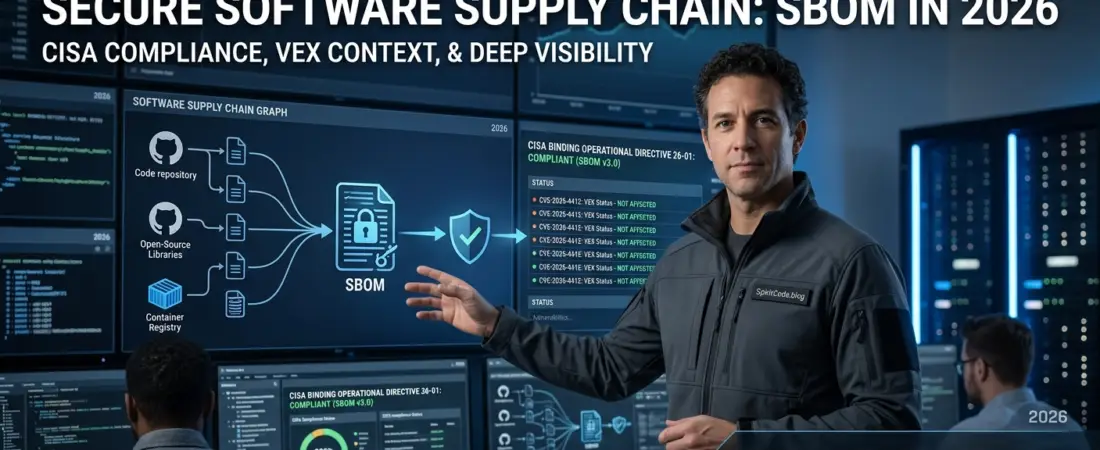
In my decade of navigating the trenches of AppSec and DevOps here in the US, I’ve seen plenty of “mandatory” trends come and go. But as we sit here in 2026, the secure software supply chain SBOM 2026 landscape isn’t just another trend—it’s the law of the land.
If you’re selling software to the federal government or operating in critical infrastructure sectors like finance or energy, the “grace period” for the Executive Order 14028 is long gone. I’ve spent the last two years helping enterprises transition from panic-buying tools to actually building resilient systems. Here is my take on where we stand and how I’m handling it.
The 2026 Reality Check: It’s Not Optional Anymore
I remember back in 2022 when people treated the CISA SBOM requirements as a distant “maybe.” Fast forward to today: if you don’t have a verifiable, machine-readable Software Bill of Materials, your federal contracts are being frozen.
The Biden-era mandates have matured. CISA’s “Self-Attestation” forms are now strictly audited. In my experience, the biggest shift hasn’t been the requirement itself, but the granularity. It’s no longer enough to list your top-level dependencies. Auditors are now looking for deep-tree visibility and proof of provenance. If you can’t tell me where that obscure C-library in your container came from, you have a massive liability on your hands.
Tooling Overload: Why Management is the Real Nightmare
I’ll be honest with you: generating an SBOM is the easy part. In 2026, every build tool and CLI has a “generate-sbom” flag. The real headache—the one that keeps me up at night—is SBOM automation tooling sprawl and management.
I’ve seen teams generate thousands of JSON files every week, only for them to sit rotting in an S3 bucket. That’s not security; that’s digital hoarding. The challenge I see most often is the “Data Silo” problem:
- Security teams have their scanners.
- DevOps teams have their CI outputs.
- Legal teams have their license compliance tools.
Without a centralized SBOM management platform that can aggregate and deduplicate these files, you’re just creating noise, not safety.
My Actionable Strategy: Integrating SBOMs into CI/CD Without Friction
One of the most frequent questions I get is: “How do I do this without breaking my build times?” I’ve refined a workflow that I use across most of my modern Kubernetes deployments, and it boils down to three steps:
- In-Pipeline Generation: I use lightweight scanners like Trivy or Syft directly in the CI runner. I’ve found that generating a CycloneDX or SPDX v3.0 manifest at the “Build” stage is the only way to capture the ephemeral state of the environment.
- The “Gate” vs. “Audit” Philosophy: I never fail a build just because an SBOM was generated. However, I do fail the build if the SBOM cannot be signed (using Cosign/Sigstore). This ensures software supply chain security best practices are followed by guaranteeing that what we built is exactly what we’re deploying.
- Automated Registry Injection: I automate the pushing of the SBOM to the OCI registry alongside the image. It makes the “discovery” phase much easier for the runtime security tools I use later.
CycloneDX vs SPDX 2026: Which one do I choose?
I get asked this a lot. In my opinion, CycloneDX has won the “Developer Experience” war for web and cloud-native apps due to its lightweight JSON structure. However, for deep compliance and legacy system interoperability, SPDX v3.0 is the gold standard I use for federal-grade documentation. My advice? Support both, but lead with CycloneDX for internal agility.
The VEX Component: Why an SBOM Alone is Inexpensive Paperwork
Here is a hard truth I’ve learned the hard way: An SBOM without VEX (Vulnerability Exploitability eXchange) is useless in 2026.
Why? Because of Vulnerability Noise. A standard SBOM for a modern microservice might flag 300 “Critical” vulnerabilities. But as a Senior Engineer, I know that 295 of those aren’t actually reachable in my specific execution path.
VEX allows me to tell the scanner: “Yes, I see CVE-2026-XXXX, but it is NOT exploitable because I don’t use that specific function.” * Without VEX, your security dashboard is a sea of red.
- With VEX, you provide the context that saves your developers from hours of “dependency hell” refactoring.
Final Thoughts: The Spirit of the Code
Securing the supply chain isn’t just about satisfying a CISA auditor. It’s about the integrity of what we build. When I look at a manifest, I don’t just see a list of libraries; I see the “ingredients” of our digital world.
In 2026, being a “Senior Developer” means taking responsibility for those ingredients. Stop treating SBOMs as a checkbox and start treating them as the foundation of your deployment’s trust.